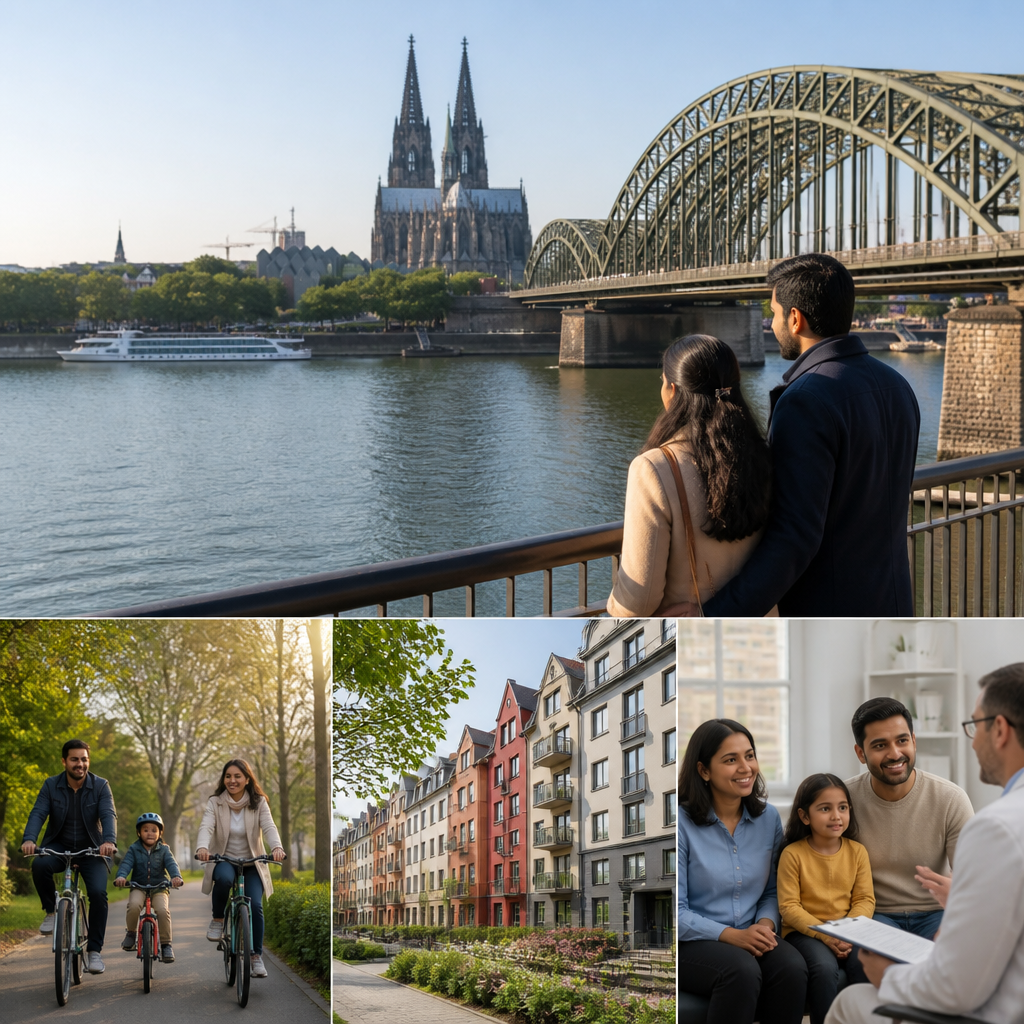
Cologne sits on the Rhine between Bonn and Düsseldorf, the largest city in North Rhine-Westphalia and Germany's fourth-largest urban centre. For Indian expats, Cologne offers something many German cities struggle to deliver: a genuinely laid-back, liberal culture that welcomes newcomers without asking them to shed their identity at the door. The city is renowned for combining Roman history and medieval architecture with beer halls, carnivals, and a surprisingly diverse food scene—including a small but established Indian community that has been here since the 1980s.
This is your root guide to settling in Cologne as an Indian professional or family. It will orient you to the major steps—arrival and registration, housing, transport, healthcare, schools, work, and daily life—and point you to the deeper topic articles on Expatskey where each area is covered in full. Cologne is not Berlin's startup chaos or Munich's buttoned-up formality; it is Germany's oldest city with a young soul, and it rewards those who take the time to understand how it works.
Arrival and Registration: The Anmeldung Process in Cologne
The first administrative task after landing in Cologne is Anmeldung—the mandatory registration of your address with the city. This is not optional, and it is the foundation for everything that follows: opening a bank account, applying for a residence permit, enrolling children in school, and receiving your tax identification number.
What Anmeldung Is and Why It Matters
Anmeldung must be completed within two weeks of moving into your accommodation. You register at the local citizens' office, the Bürgeramt, and the process results in a certificate called the Meldebescheinigung (confirmation of registration). This certificate is your proof of residence and will be requested by banks, insurance providers, schools, and the immigration office.
Documents You Need
To register, bring:
- Your passport
- Your visa and entry stamp
- Your rental contract (Mietvertrag)
- A signed confirmation from your landlord, the Wohnungsgeberbestätigung (landlord confirmation form)
- A completed registration form (available at the Bürgeramt or downloadable in advance)
Booking Your Appointment
Cologne's Bürgeramt offices require appointments, and slots fill quickly. The city's official portal is where you book; do not wait until you arrive to secure a slot. If you are arriving during peak periods—such as the start of the academic year or after major holidays—appointments may be scarce. Book as soon as you have a rental contract in hand.
The sources for this article do not publish current processing times or fees for Anmeldung in Cologne. Check the city's official portal for up-to-date information on what to expect at your appointment.
What Happens After Registration
Once you complete Anmeldung, your tax identification number (Steuer-ID) is automatically issued and will arrive by post within a few weeks. You will also be able to open a German bank account, apply for health insurance, and begin the residence permit process if your visa requires it.
For a full walkthrough of the Anmeldung process, including how to handle complications with landlords who are reluctant to provide the Wohnungsgeberbestätigung, see the dedicated Anmeldung guide on Expatskey.
Visas and Residence Permits: What Indian Expats Need to Know
Your visa determines your legal status in Germany, and it must be converted into a residence permit after arrival. The type of visa you hold—whether it is a work visa, EU Blue Card, student visa, or family reunification visa—will dictate your next steps.
The Residence Permit Application
After completing Anmeldung, you must apply for your residence permit at the Ausländerbehörde (foreigners' office) in Cologne. You will need your Meldebescheinigung, your passport, your employment contract (if applicable), proof of health insurance, and biometric photos.
The sources for this article do not state the current processing time or fees for residence permits in Cologne. Contact the Ausländerbehörde directly or check the city's official portal for the latest information. Appointments are mandatory, and delays are common, so apply as early as your visa allows.
For detailed guidance on visa categories, required documents, and how to extend or change your permit, refer to Expatskey's dedicated visa and residence permit articles.
Finding Housing in Cologne: Neighbourhoods, Rental Market, and Practicalities
Cologne's rental market is competitive, but it is not as brutal as Munich or Frankfurt. The city is large enough to offer variety, and if you are flexible about location, you will find something that works.
How the Rental Process Works
Most rentals in Cologne are unfurnished, which in Germany means they may lack kitchen cabinets, light fixtures, and appliances. Expect to pay a security deposit (Kaution) of up to three months' rent. Rental contracts distinguish between Kaltmiete (cold rent, the base amount) and Warmmiete (warm rent, which includes heating and sometimes water). Always clarify what is included.
You will need the Wohnungsgeberbestätigung from your landlord to complete Anmeldung, so ensure this is discussed before signing the contract.
Neighbourhoods to Consider
Cologne is divided into neighbourhoods, each with its own character:
- Innenstadt and Altstadt: The historic centre, close to the cathedral and the Rhine. Convenient but expensive and touristy.
- Ehrenfeld: Popular with young professionals and families, known for its multicultural vibe, cafés, and street art. Well-connected by tram.
- Nippes: A quieter, family-friendly area north of the centre, with good schools and parks.
- Sülz and Lindenthal: Green, residential, and close to the university. Suitable for families.
- Deutz: On the right bank of the Rhine, offering good transport links and slightly lower rents.
- Mülheim: An up-and-coming area with affordable housing, though less central.
The sources for this article do not provide current rental prices or availability data for Cologne. Check local portals and speak to relocation agents for up-to-date figures.
Where to Search
Online portals are the primary way to find housing in Germany. Prepare a strong application package—German landlords expect a CV, proof of income, and a Schufa credit report. Competition is real, and landlords often receive dozens of applications for a single flat.
For a full guide to the rental process, tenant rights, and how to navigate the Schufa system, see Expatskey's dedicated housing article.
Public Transport in Cologne: The KVB Network
Cologne's public transport is managed by the KVB (Kölner Verkehrsbund), which operates a comprehensive network of trams (Stadtbahn), buses, and regional trains. The system is efficient, and most of the city is accessible without a car.
How the System Works
The KVB network is divided into fare zones, and tickets are priced according to the zones you travel through. You can buy single tickets, day tickets, or monthly passes. Tickets must be validated before boarding if purchased from a machine; tickets bought via the KVB app are automatically validated.
The inner city is walkable, and many major sites—including the cathedral, the Rhine promenade, and the Altstadt—are within easy reach on foot.
Tickets and Passes
The sources for this article do not state the current prices for KVB tickets or monthly passes. Check the KVB's official website or app for the latest fares.
For expats commuting to nearby cities such as Bonn or Düsseldorf, regional trains (S-Bahn and RE lines) are frequent and reliable. Cologne's main station, Köln Hauptbahnhof, is a major hub.
For a complete guide to navigating Cologne's transport system, including tips on cycling infrastructure and car ownership, see the transport article on Expatskey.
Healthcare and Insurance: Navigating the German System
Germany's healthcare system is mandatory, comprehensive, and split into two tracks: statutory health insurance (gesetzliche Krankenversicherung) and private health insurance (private Krankenversicherung). As an Indian expat, you must have health insurance before you can complete your residence permit application.
Statutory vs. Private Insurance
Most employees are automatically enrolled in statutory insurance, which is income-based and covers dependents at no additional cost. If your salary exceeds a certain threshold, you may opt for private insurance, but this is not always advisable for families.
Registering with a Doctor
Once you have insurance, register with a general practitioner (Hausarzt) in your neighbourhood. The Hausarzt is your first point of contact for most medical issues and will refer you to specialists if needed.
The sources for this article do not provide details on healthcare costs, waiting times, or insurance premiums in Cologne. Speak to your employer's HR department or consult an insurance broker for guidance tailored to your situation.
For a full breakdown of how the German healthcare system works, including dental care, prescriptions, and maternity services, refer to Expatskey's healthcare guide.
Education and Childcare: Schools and Kitas in Cologne
If you are moving to Cologne with children, education and childcare will be among your first concerns. Germany offers a mix of public, private, and international schools, as well as subsidised childcare from infancy.
Childcare (Kitas)
Kitas (Kindertagesstätten) provide care for children from infancy to school age. Demand for Kita places in Cologne is high, and waiting lists are common. Register as early as possible—ideally before you arrive.
The sources for this article do not state the current fees or availability for Kitas in Cologne. Contact the city's youth welfare office (Jugendamt) or check the official portal for information on how to apply.
Schools
Cologne offers public schools (which are free and teach in German), private or alternative schools (such as Montessori or Waldorf), and international schools (which teach in English or other languages and follow curricula such as the IB or IGCSE).
If your children do not speak German, an international school may be the best option for the first few years. Public schools can be excellent, but integration takes time and language support varies.
The sources for this article do not name specific schools or provide current enrolment information. Research schools in your chosen neighbourhood and contact them directly to understand admissions processes and waiting lists.
For a comprehensive guide to the German school system, including how to choose between school types and what to expect from the curriculum, see Expatskey's education article.
Work and Career: The Cologne Job Market
Cologne's economy is diverse, with strengths in media, telecommunications, insurance, automotive, and logistics. The city is home to major employers and a growing startup scene, and English-speaking roles are available, particularly in tech, finance, and multinational corporations.
Finding Work
Most job searches in Germany happen online, through company websites, and via professional networks. German-language skills are an asset, even in English-speaking roles, and many employers expect at least conversational proficiency.
Work Culture
German work culture emphasises punctuality, structure, and a clear separation between work and personal life. The standard workweek is around 40 hours, and paid vacation starts at 20 to 30 days per year. Cologne's culture is more relaxed than in some other German cities, but professionalism is still expected.
For detailed advice on job hunting, CV formats, and workplace norms, see Expatskey's work and career guide for Germany.
Money and Banking: Setting Up Your Finances
A German bank account is essential for receiving your salary, paying rent, and setting up direct debits. Most regular payments in Germany run through the SEPA direct debit system, and landlords and utility providers expect you to have a local account.
Opening a Bank Account
To open an account, you will need your passport, your Meldebescheinigung, and in many cases your tax identification number. Some banks require your Anmeldung to be complete before they will process your application.
You can choose between traditional high street banks and app-based digital banks, several of which offer English-language onboarding and lower fees.
Understanding Taxes
Germany's tax system is progressive, and income tax is deducted at source. You will also pay contributions to social security, health insurance, and pension funds. The sources for this article do not state the current tax rates or social security contribution levels. Consult a tax advisor who understands the double taxation avoidance agreement between India and Germany to plan your finances effectively.
For a full guide to banking, taxes, and financial planning in Germany, refer to Expatskey's money and finance article.
Culture and Daily Life: Settling Into Cologne
Cologne is known for its open, friendly character, and the city's residents—Kölner—are proud of their distinct identity. The local dialect, also called Kölsch, is still spoken, and the city's love of beer, carnival, and the Rhine is woven into daily life.
The Cologne Carnival (Fastelovend)
Carnival is the city's defining event, celebrated from New Year's Day to Ash Wednesday, with the main festivities during the "Crazy Days" from Weiberfastnacht to Aschermittwoch. The highlight is the Rose Monday parade, when Cologne's streets fill with costumes, music, and processions. Spectators shout "Kamelle!" and "Sträuße!" (sweets and flowers in Kölsch dialect) to catch treats thrown from floats.
Annual Events
Cologne hosts several major events throughout the year:
- Cologne Pride: One of Europe's largest LGBTQ+ celebrations, held in summer.
- Christmas Markets (Weihnachtsmärkte): From mid-November, the city's squares fill with market stalls selling Glühwein, Reibekuchen, and handmade gifts.
The Rhine and Outdoor Life
The Rhine River is Cologne's lifeblood, and the promenades on both banks are popular for walking, cycling, and socialising. The city's green spaces and proximity to the countryside make it easy to escape urban life when needed.
The Indian Community in Cologne: Groceries, Restaurants, and Connections
Cologne's Indian community is small but established, with roots going back decades. You will find Indian groceries, restaurants, and cultural organisations that can help you settle in and maintain connections to home.
Indian Groceries
For authentic Indian ingredients, spices, and staples, Cologne has several dedicated stores:
Indian Restaurants
Cologne's Indian dining scene includes long-established restaurants serving North Indian cuisine:
Community and Cultural Organisations
Indian expats in Cologne have access to cultural and spiritual organisations, including:
For sports and social connections, the Indian Sports Association Cologne brings together South Asian communities through cricket, football, and other activities:
Final Thoughts: Making Cologne Home
Cologne is a city that rewards those who engage with it. It is not as polished as Munich or as fast-paced as Berlin, but it offers something more valuable: a genuine sense of welcome and a quality of life that balances work, culture, and community. For Indian expats, the city provides the infrastructure and services you need, alongside a small but supportive community that understands the challenges of settling in a new country.
Start with the basics—Anmeldung, housing, insurance, and transport—and then take the time to explore the neighbourhoods, learn a few words of Kölsch, and join the crowds at carnival. Cologne is Germany's oldest city, but it has never stopped evolving, and it is ready for you to make it yours.
For deeper guidance on every topic covered here, explore Expatskey's dedicated articles on visas, housing, healthcare, schools, and more. Settling in takes time, but with the right preparation, Cologne will feel like home sooner than you expect.