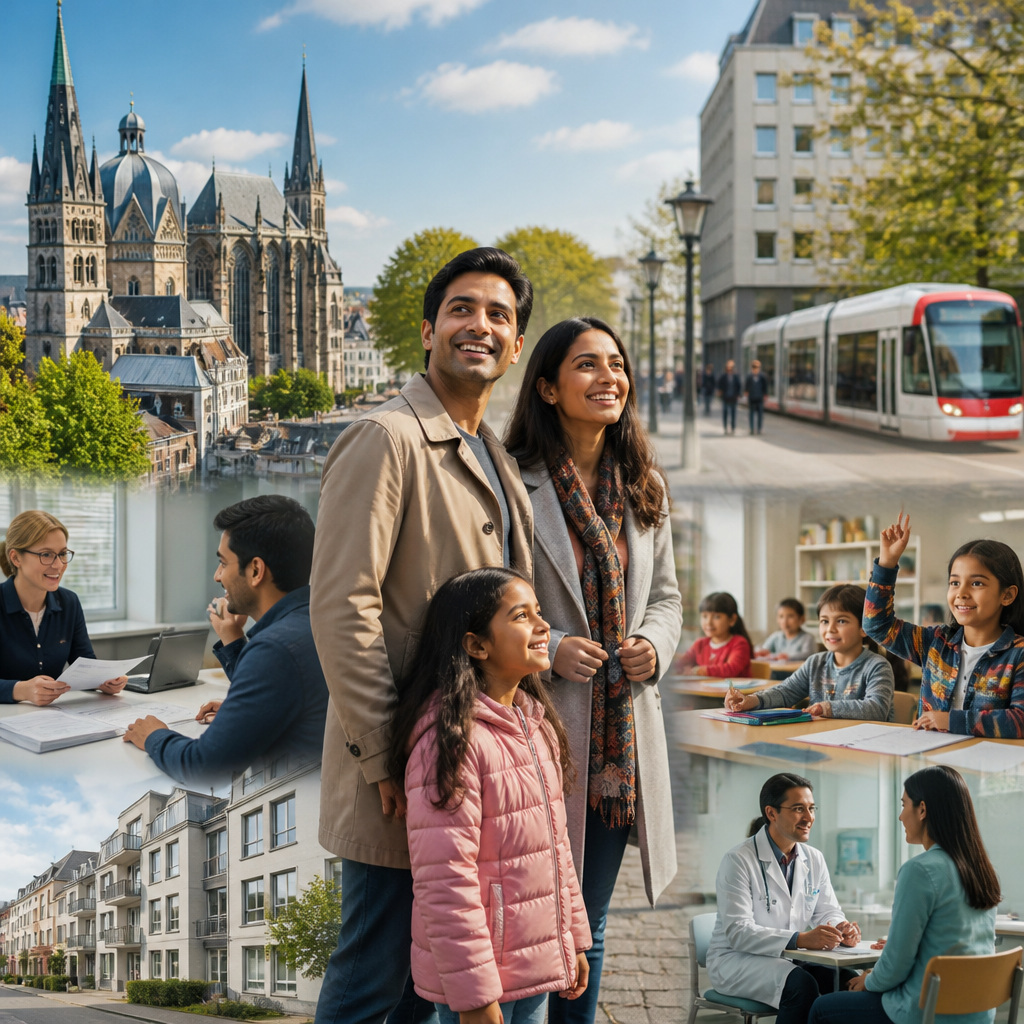
Aachen is quietly becoming one of the most practical choices for Indian expats in Germany. Tucked into the western corner of North Rhine-Westphalia, where Germany meets Belgium and the Netherlands, this historic city offers something rare: the infrastructure and international atmosphere of a major tech and research hub, without the eye-watering rents of Munich or the overwhelming scale of Berlin. For Indian professionals, researchers, and students, Aachen delivers a balanced quality of life—affordable housing, excellent public transport, a genuine Indian community, and the kind of bureaucratic efficiency that makes settling in Germany considerably less stressful.
This is your root guide to making Aachen home. We'll walk you through the essentials—arrival formalities, housing realities, navigating healthcare and schools, getting around, and finding your community—with practical orientation to each area and links to deeper topic guides where you need them.
Why Indian Expats Choose Aachen
Aachen's appeal is straightforward. It's home to RWTH Aachen University, one of Europe's leading technical universities, and a dense ecosystem of engineering, automotive, and IT companies. That means jobs for skilled professionals, a large international population (students and expats make up a significant portion of residents), and an environment where English gets you surprisingly far, even if your German is still developing.
The city is compact and cyclable, costs are reasonable compared to Germany's larger metros, and the tri-border location means weekend trips to Maastricht, Liège, or the Dutch countryside are a short train ride away. Importantly for Indian families, Aachen has established Indian grocery stores, active community groups, and a growing number of expats who've been exactly where you are now.
Community feedback consistently highlights Aachen as "a nice city" with "decent rental costs compared to bigger cities like Köln, Düsseldorf, München," and with Indian grocery stores readily available—practical considerations that matter when you're planning a move halfway across the world.
Arrival and Registration: Your First Two Weeks
Anmeldung: The Non-Negotiable First Step
The single most important administrative task when you arrive in Aachen is your Anmeldung—the city registration. German law requires everyone, without exception, to register their residential address at the local Bürgeramt (Citizens' Office) within two weeks of moving in. This isn't a formality you can postpone; it's the foundation for nearly everything else: opening a bank account, activating health insurance, applying for or extending residence permits, and receiving official mail.
What you need for Anmeldung:
- Your passport
- Wohnungsgeberbestätigung (landlord confirmation)—a signed document from your landlord or housing provider confirming you live at that address. No exceptions: without this, the Bürgeramt will not register you.
- Completed Anmeldung form (often available for download on the city's website, or provided at the appointment)
- If you're registering a family, bring passports and birth certificates for all members
The process: Most Bürgeramt offices in Aachen allow you to book an appointment online through the city's official portal. Do this as soon as you have a confirmed address—appointment slots can fill quickly, especially at the start of university semesters. If online booking isn't available, call or visit in person to request a slot.
Bring all original documents to your appointment. If your German is limited, bring a German-speaking friend or colleague; while some staff speak English, administrative appointments can involve specific terminology. The Anmeldung itself is typically free in most German cities, though a small number of registration offices charge between €10 and €20; the official sources for this article do not specify Aachen's exact fee, so confirm this when you book.
You'll receive a Meldebescheinigung (registration certificate) at the end of the appointment. Keep multiple copies—you'll be asked for it repeatedly in your first months.
Consequences of missing the deadline: Failing to register within two weeks can result in fines. More practically, you cannot open a German bank account, complete health insurance enrollment, or proceed with many residence permit steps without proof of registration. It's the single document that unlocks your new life in Aachen, so prioritize it above almost everything else.
For a detailed walkthrough of the Anmeldung process, documents, common pitfalls, and how to handle it if you're moving between cities within Germany, see our dedicated City Registration (Anmeldung) Guide.
Residence Permits and Visas
If you've arrived on a work visa, EU Blue Card, student visa, or family reunion permit, your Anmeldung certificate is required before you can complete your residence permit formalities at the Ausländerbehörde (Foreigners' Office). The specifics—required documents, appointment booking, processing times—vary by visa category and are beyond the scope of this city overview.
Consult our Visa and Residence Permit Hub for category-specific guidance, and check the official North Rhine-Westphalia state portal and Aachen city website for the most current procedures and contact details.
Housing: Neighbourhoods, Costs, and the Search Process
The Aachen Housing Market
Aachen's rental market is tight but navigable. As a university city with a large student population, competition for apartments is real, especially in the weeks before the winter and summer semesters. However, compared to Germany's tier-one cities, rents are "decent"—a recurring theme in expat feedback—and the city is small enough that most neighborhoods are practical for commuting.
What to expect: You'll encounter a mix of older buildings (common in the Altstadt and inner districts), post-war apartment blocks, and newer developments on the outskirts. Furnished apartments are rare outside of student housing or short-term rentals; expect to rent unfurnished and either bring or buy furniture.
Rental listings typically quote "Kaltmiete" (cold rent, the base rent excluding utilities) and "Warmmiete" (warm rent, including heating and sometimes water). Budget for Nebenkosten (additional costs like building maintenance, trash collection, and sometimes internet) on top of the Warmmiete. The official sources for this article do not publish specific rent ranges for Aachen, so check current listings on ImmobilienScout24, WG-Gesucht, and eBay Kleinanzeigen, and budget conservatively when planning your move.
Wohnungsgeberbestätigung and Anmeldung dependency: You cannot complete your Anmeldung without the landlord confirmation, and many services (bank accounts, insurance activation) require your Anmeldung certificate. This creates a circular dependency that catches many newcomers. The solution: communicate clearly with your landlord or housing provider before you move in, and ensure the Wohnungsgeberbestätigung is ready on day one. Reputable landlords and companies understand this and will have the document prepared; if a landlord is evasive about providing it, that's a red flag.
Practical Neighbourhoods for Indian Expats
Aachen is divided into several districts, each with its own character:
- Aachen-Mitte (City Centre): Convenient for shopping, dining, and public transport, but can be pricier and noisier. Good for singles or couples who prioritize walkability.
- Burtscheid: Just south of the centre, quieter, with good connections and a mix of families and young professionals.
- Brand: A family-friendly district to the northeast, with green spaces, schools, and a more suburban feel. Popular with expat families.
- Laurensberg: Residential, leafy, and well-connected by bus. A solid choice if you're working at RWTH or nearby research institutes.
- Richterich and Horbach: Further out, more spacious, and often more affordable. Requires a longer commute but offers a quieter lifestyle.
The official sources do not provide specific rent figures by neighbourhood, so explore listings in your target districts and compare. Many Indian expats gravitate toward areas with good bus or tram links to RWTH, the city centre, and major employers, balancing commute time against rent and space.
The Search and Application Process
German rental applications are formal. Expect to provide:
- Proof of income (employment contract, recent payslips)
- Schufa credit report (a German credit check; you can order one online even before arrival)
- Copy of your passport and, once you have it, your Anmeldung certificate
- Sometimes a Mietschuldenfreiheitsbescheinigung (certificate from your previous landlord confirming no rent debts)
Landlords often receive dozens of applications for a single apartment, so responsiveness, completeness, and a polite cover letter (in German, if possible) matter.
Short-term solutions: If you're arriving without a permanent apartment, consider booking a serviced apartment, Airbnb, or a room in a shared flat (WG) for your first weeks. Some companies, like POHA House, offer move-in-ready furnished housing in Aachen specifically designed for expats and students, which can bridge the gap while you search for a long-term place. Once you have a fixed address, complete your Anmeldung immediately, even if it's temporary housing—you can re-register when you move to a permanent apartment.
For a full breakdown of the German rental process, tenant rights, contracts, deposits, and how to avoid common pitfalls, see our Housing and Renting in Germany Guide.
Work and Employment
Aachen's economy revolves around RWTH Aachen University, research institutes, and a cluster of engineering, automotive, IT, and consulting firms. Major employers include FEV, Ericsson, Grünenthal, Aixtron, and a host of smaller tech and manufacturing companies. Many roles, especially in engineering and IT, are open to English speakers, though German proficiency significantly expands your opportunities and is often expected for client-facing or management positions.
Work permits and the EU Blue Card: If you're arriving on a work visa or EU Blue Card, your employer will typically guide you through the initial visa process. Once in Aachen, your Anmeldung and residence permit registration at the Ausländerbehörde are the next steps. The EU Blue Card, aimed at highly skilled non-EU workers, offers a streamlined path to permanent residence and is widely used by Indian IT and engineering professionals in Germany.
Taxes and social contributions: German employment comes with automatic deductions for income tax, health insurance, pension, unemployment insurance, and long-term care insurance. These are withheld at source, and you'll see them itemized on your monthly payslip. The official sources do not state the exact percentage rates for Aachen or North Rhine-Westphalia, so consult your employer's HR department or a tax advisor (Steuerberater) for precise figures based on your salary and tax class.
For guidance on German employment contracts, tax classes, payslips, and workplace culture, see our Working in Germany Hub.
Money and Banking
Opening a Bank Account
You'll need a German bank account to receive your salary, pay rent (via SEPA direct debit), and handle utilities and phone bills. Most banks require your Anmeldung certificate to open an account, creating the circular dependency mentioned earlier: you need Anmeldung to open the account, but you may need an account to receive your first salary or unblock a blocked account.
The workaround: Bring accessible funds (beyond any blocked account) to cover your first weeks. Some expats report needing roughly €2,000 in buffer funds to handle deposits, initial rent, and living costs before the first paycheck arrives, though the official sources for this article do not specify an exact figure—budget conservatively based on your housing and living arrangements.
Choosing a bank: Options include traditional banks (Sparkasse, Deutsche Bank, Commerzbank) and digital banks (N26, Comdirect, DKB). Some offer English-language support, free accounts for students or young professionals, and easy online account opening. Compare fees, ATM access, and customer service language options before deciding.
For a detailed comparison of German banks, account types, fees, and the step-by-step account opening process, see our Banking and Finance Guide.
Healthcare and Insurance
Health Insurance: Mandatory and Non-Negotiable
Germany requires everyone to have health insurance, and for employees, it's typically arranged through your employer. You'll choose between statutory health insurance (gesetzliche Krankenversicherung, GKV) and private health insurance (private Krankenversicherung, PKV), depending on your salary and employment type. Most Indian expats on standard employment contracts are enrolled in GKV, which covers a comprehensive range of services and includes your dependents.
Activating your insurance: Your employer will usually handle the paperwork, but you'll need your Anmeldung certificate to complete registration. Once active, you'll receive a health insurance card (Versichertenkarte), which you present at doctors' appointments and pharmacies.
Finding doctors and specialists: Aachen has excellent healthcare infrastructure, with general practitioners (Hausärzte), specialists, hospitals, and pharmacies throughout the city. Many doctors speak English, especially in university-adjacent areas, but it's wise to confirm language availability when booking. The German system typically requires you to visit a GP first, who will refer you to a specialist if needed.
Prescriptions and pharmacies: Pharmacies (Apotheken) are widely available and clearly marked with a red "A" sign. Prescriptions from your doctor are filled here, and pharmacists can provide over-the-counter advice for minor ailments.
For a full explanation of the German healthcare system, insurance types, how to register a family doctor, and navigating appointments, see our Healthcare and Insurance Guide.
Education and Childcare
Schools and Kitas for Families
If you're moving to Aachen with children, the German education system is free, compulsory from age six, and generally high-quality. Newcomers are supported through special language classes (Willkommensklassen or integration support), helping children transition even if they don't speak German initially.
Kindergarten (Kita): Preschool childcare (Kita) is available for children from infancy to school age. Kitas are a mix of public, church-run, and private institutions, with structured play-based learning. Demand is high, and waiting lists are common, so apply as soon as you have your Anmeldung and know your move-in date. The official sources do not specify Kita fees or waiting times for Aachen, so contact the city's Jugendamt (Youth Office) or individual Kitas directly for current availability and costs.
Primary and secondary schools: Germany's school system is tiered, with children moving to Gymnasium (academic track), Realschule, or Gesamtschule (comprehensive) after primary school, based on performance and recommendations. International schools are limited in Aachen compared to larger cities, so most expat families use the public system, often with strong results once the language barrier is crossed.
Parent networks: Parent cafés, cultural programs, and community centers organize activities and support for international families. The Indian community in Aachen (see below) often includes families who can share firsthand experience navigating schools and Kitas.
For detailed guidance on the German school system, Kita applications, and education options, see our Education and Childcare Guide.
Transport: Getting Around Aachen
Public Transport: ASEAG
Aachen's public transport is operated by ASEAG (Aachener Straßenbahn und Energieversorgungs-AG), with an extensive network of buses covering the city and surrounding areas. The system is reliable, punctual, and integrated with regional trains (Deutsche Bahn) for trips to Cologne, Düsseldorf, or across the border.
Tickets and passes: Single tickets, day passes, and monthly subscriptions (Monatstickets) are available. If you're commuting daily, a monthly pass offers the best value. Students often qualify for discounted semester tickets through RWTH. The official sources do not state exact ticket prices for Aachen, so check the ASEAG website or app for current fares and pass options.
Cycling: Aachen is bike-friendly, with dedicated lanes and a compact layout that makes cycling practical year-round (though winter weather requires preparation). Many expats combine cycling with public transport for longer trips.
Driving: If you're bringing or buying a car, you'll need to register it, arrange insurance, and eventually convert your Indian driving license to a German one (requirements vary by state and license type). Parking in the city centre is limited and often paid, so many residents rely on public transport and bikes for daily errands.
For comprehensive guidance on German public transport, cycling infrastructure, driving license conversion, and buying or leasing a car, see our Transport and Mobility Guide.
Culture and Daily Life
Indian Groceries and Restaurants
One of the recurring reassurances from Indian expats in Aachen: you won't go without your staples. The city has several well-established Indian and Asian grocery stores where you can find rice, lentils, spices, frozen snacks, fresh vegetables, and everything else you'd expect.
AIX Bazaar has become a cornerstone of the Indian expat community in Aachen, offering authentic Indian ingredients and a welcoming atmosphere for South Asian families.
Nagammaal Markt - Asian Lebensmittel is another trusted destination, serving the diverse South Asian community with care and authenticity.
New Sherona Supermarket is well-regarded for its dedication to serving the growing South Asian community in Aachen.
These stores are more than shopping destinations—they're social hubs where you'll run into familiar faces, get tips on settling in, and feel a little less far from home.
Dining out: Restaurant Mostard brings the rich tapestry of Indian cuisine to the heart of Aachen, offering a taste of home in a historic German city.
Beyond Indian restaurants, Aachen has a diverse food scene reflecting its international population—Turkish, Italian, Chinese, and traditional German options are all easy to find.
The Indian Community in Aachen
Aachen's Indian expat community is active, welcoming, and well-organized. ISA Aachen (AISA) e.V. was founded by passionate members of the Indian expat community to create a welcoming space where South Asian families could come together, celebrate festivals, share experiences, and support one another through the challenges of expat life.
Community events, Diwali celebrations, cultural programs, and informal meetups are regular features. For newcomers, connecting with AISA and other expats—through Facebook groups, InterNations, or simply striking up a conversation at AIX Bazaar—can make the difference between feeling isolated and feeling at home.
Weather and Clothing
Aachen's weather is temperate but can be grey, damp, and cold from October to March. If you're arriving in winter, pack or budget for warm clothing immediately—layered clothing, a good winter coat, waterproof shoes, and an umbrella are essentials. Many Indian expats report that the weather adjustment is one of the bigger cultural shocks, especially if you're from a warmer region, so prepare mentally and practically.
Daily Rhythms and German Directness
German communication style is famously direct, and what can feel blunt or even rude to newcomers is simply the cultural norm. Feedback is given plainly, small talk is minimal in professional settings, and punctuality is non-negotiable. Understanding this in advance—reading up on German workplace and social culture before you arrive—smooths the transition considerably.
Sundays and public holidays are quiet: most shops are closed, and the city slows down. Use the time to explore, rest, or connect with the community. Aachen's location near the Belgian and Dutch borders means weekend trips are easy and offer a change of pace.
For deeper insights into German cultural norms, integration challenges, and strategies for building your social network, see our Culture and Integration Guide.
Practical Checklist: Your First Month in Aachen
Here's what to prioritize in your first 30 days:
Week 1:
- Arrive and settle into temporary or permanent housing
- Obtain Wohnungsgeberbestätigung from your landlord
- Book your Anmeldung appointment at the Bürgeramt (do this immediately)
- Activate your health insurance (via employer or directly)
- Get a German SIM card (often requires Anmeldung, so use a prepaid option initially if needed)
Week 2:
- Attend your Anmeldung appointment and receive your Meldebescheinigung
- Open a German bank account
- Register or extend your residence permit at the Ausländerbehörde (if applicable)
- Explore your neighbourhood: locate the nearest supermarket, pharmacy, and public transport stops
Weeks 3–4:
- Set up utilities and internet (often handled by landlord, but confirm)
- Register children for Kita or school (if applicable)
- Connect with the Indian community (AISA, Facebook groups, grocery stores)
- Familiarize yourself with public transport routes and consider a monthly pass
- Start building a routine: commute, shopping, socializing
Ongoing:
- Learn German: even basic conversational skills make daily life significantly easier
- Budget and track expenses as you settle into the local cost of living
- Explore Aachen and the surrounding region—Maastricht, Liège, and Cologne are all close
Where to Go for More Help
This guide is your starting point, not your ending point. Aachen's official city website, RWTH's international office (if you're connected to the university), and the North Rhine-Westphalia state portal all publish current information on registration, permits, and services. The Indian community groups—both online and in person—are invaluable for real-time advice, recommendations, and support.
For topic-specific depth, explore our dedicated guides:
- City Registration (Anmeldung) Guide for step-by-step instructions and troubleshooting
- Visa and Residence Permit Hub for category-specific requirements
- Housing and Renting in Germany Guide for contracts, tenant rights, and search strategies
- Healthcare and Insurance Guide for navigating the German medical system
- Education and Childcare Guide for schools, Kitas, and family support
- Transport and Mobility Guide for public transport, cycling, and driving
- Banking and Finance Guide for accounts, taxes, and money management
- Working in Germany Hub for employment, contracts, and workplace culture
- Culture and Integration Guide for social norms, language learning, and building your network
Final Thoughts
Aachen won't overwhelm you the way Berlin or Munich might, but it also won't leave you wanting for infrastructure, opportunity, or community. It's a city that works—efficiently, predictably, and with enough international character that you'll find your place without losing your identity. The bureaucracy is real, the weather takes getting used to, and the language barrier is genuine, but thousands of Indian expats have navigated exactly this path before you, and the city has the systems, services, and community to support you as you do the same.
Take it one step at a time, starting with that Anmeldung appointment. Everything else follows from there. Welcome to Aachen.