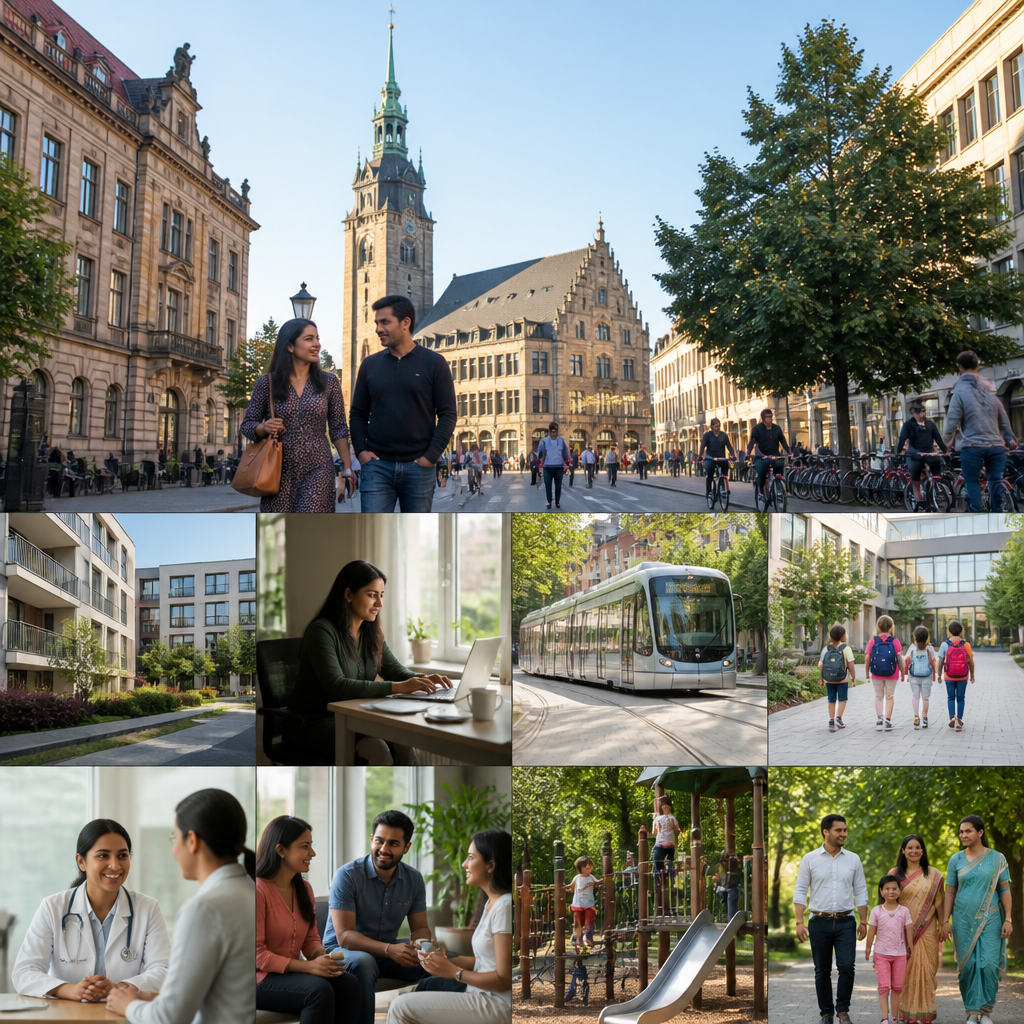
Erlangen, a compact Bavarian city of approximately 115,928 residents, offers Indian expats a distinctive blend of academic excellence, economic stability, and small-town livability just 20 minutes north of Nuremberg. Home to Friedrich-Alexander University and the headquarters of Siemens Healthcare, this Middle Franconian city attracts professionals and researchers from across the globe, including a growing Indian community drawn by its technology sector, research institutions, and high quality of life.
The city's reputation for safety—with low crime rates and strong police presence—combined with excellent cycling infrastructure, comprehensive public transport connections, and proximity to Nuremberg's international airport makes it particularly attractive for families and young professionals. Unlike Germany's larger cities, Erlangen offers shorter administrative wait times, more manageable housing markets, and a genuinely walkable urban core where most daily needs sit within cycling distance.
This guide walks you through the essential steps of establishing your life in Erlangen: from your mandatory address registration to finding housing, navigating healthcare, enrolling children in schools, and connecting with the Indian community. Each section orients you to what matters most and points you toward the detailed topic articles on Expatskey where you'll find the depth you need for each area.
Arrival and City Registration: Your First Administrative Steps
The Anmeldung Requirement
German law requires all residents to register their address at the local Bürgeramt (Citizens' Office) within two weeks of moving into a permanent residence. This registration, called Anmeldung, is not optional paperwork—it is the administrative foundation for nearly everything that follows. Without completing your Anmeldung, you cannot open a German bank account, register for a German SIM card or phone contract, access public health insurance, receive your tax identification number (Steuer-ID), or complete many employment onboarding processes.
The registration produces an official certificate (Meldebescheinigung) that serves as proof of your German address. This document will be requested repeatedly during your first months: by banks, insurance providers, employers, schools, and government offices.
Booking Your Registration Appointment in Erlangen
Most German cities, including Erlangen, allow you to schedule your registration appointment online through the official city website at www.erlangen.de. If online booking is unavailable or fully booked, you can call the Bürgeramt directly or visit in person to request an appointment. Schedule this appointment as soon as you have a confirmed address—waiting lists can extend several weeks in some Bavarian cities, though Erlangen's smaller size typically means shorter wait times than Munich or Nuremberg.
Documents Required for Anmeldung
Gather these documents before your appointment:
- Your passport (original, not a copy)
- Wohnungsgeberbestätigung (landlord confirmation of residence)—your landlord or housing provider must complete and sign this form confirming you live at the address
- Completed Anmeldung form (available online on the city website or at the Bürgeramt)
- Birth certificates for any children you are registering
- Marriage certificate if registering with a spouse
If you don't speak German yet, bringing a German-speaking friend or colleague to your appointment is advisable, particularly for clarifying any questions the registration officer might have.
Registration Fees
In most German cities, city registration is free of charge. Some registration offices charge between €10 and €20 for the Anmeldung process, though the official sources for this article do not specify Erlangen's exact fee structure. Check the Erlangen city website or ask when booking your appointment to confirm whether any fee applies.
Consequences of Missing the Deadline
Failing to register within the two-week deadline can result in fines. More significantly, delays in registration create cascading delays in everything that depends on it: you cannot begin the residence permit application process, open bank accounts, or access essential services until your address is officially registered. The two-week requirement is strictly enforced, so prioritize this step immediately upon arrival.
For comprehensive guidance on the Anmeldung process, documentation requirements, and what to expect at your appointment, consult Expatskey's detailed article on city registration in Germany.
Visas and Residence Permits: Legal Status in Bavaria
If you are arriving from India on a work visa, student visa, or family reunification visa, your initial visa allows entry into Germany but must be converted into a residence permit (Aufenthaltstitel) after arrival. This conversion happens at the Ausländerbehörde (Foreigners' Office), and you must complete your Anmeldung before the Ausländerbehörde will schedule your appointment.
The official sources for this article do not provide specific processing times or fee schedules for Erlangen's Ausländerbehörde. Contact the office directly through the Erlangen city portal to confirm current wait times, required documentation, and applicable fees for your specific visa category.
Expatskey's dedicated articles on German work visas, student visas, and family reunification visas provide detailed guidance on eligibility requirements, application processes, and what to prepare before your Ausländerbehörde appointment.
Housing in Erlangen: Neighbourhoods and the Rental Market
Overview of Erlangen's Housing Market
Erlangen's housing market sits somewhere between the extreme pressure of Munich and the more accessible markets of smaller Bavarian towns. As a university city with a major corporate employer (Siemens Healthcare), demand for quality housing remains consistently high, particularly in neighbourhoods close to the university or with good transport connections. However, the city's compact size—just 76.96 square kilometers—means that even "distant" neighbourhoods remain within easy cycling or bus distance of the center.
The official sources for this article do not publish average rental prices, vacancy rates, or typical deposit amounts for Erlangen. Check current rental listings on platforms like ImmobilienScout24 and WG-Gesucht to understand prevailing market rates before budgeting for your move.
Key Neighbourhoods for Expats
Erlangen is divided into nine city districts. While the sources do not provide detailed descriptions of each district's character, expats typically prioritize neighbourhoods based on proximity to workplaces (particularly Siemens and the university), school access, and transport connections.
When evaluating neighbourhoods, consider:
- Distance to your workplace: Erlangen is bike-friendly with excellent cycling infrastructure, so a 3-5 kilometer commute by bicycle is entirely practical year-round
- Public transport connections: The city has an extensive bus network, and Erlangen is served by Nuremberg S-Bahn Line 1, connecting you to Nuremberg and the broader regional network
- School catchment areas: If you have children, proximity to well-regarded Grundschulen (primary schools) or Gymnasien (secondary schools) may influence your choice
- Access to Indian groceries: Several Asian and Indian grocery stores operate in Erlangen, and choosing housing with reasonable access to these shops simplifies weekly shopping
The Wohnungsgeberbestätigung: Your Landlord's Role
German law requires your landlord to provide a signed Wohnungsgeberbestätigung (landlord confirmation) before you can complete your Anmeldung. This form confirms that you live at the address and is mandatory for registration. Some landlords, particularly private individuals unfamiliar with expat tenants, may be slow to provide this document or may not understand its urgency. Clarify with your landlord before signing the lease that you will need this form immediately upon move-in, and confirm they understand their legal obligation to provide it.
Choosing housing providers who regularly work with international tenants and understand the Anmeldung timeline can significantly compress your administrative timeline and allow you to start building your life in Germany from week one rather than week six.
Finding Housing: Practical Steps
Start your housing search before arriving in Germany if possible. The most widely used platforms are ImmobilienScout24, WG-Gesucht (for shared flats), and local Facebook groups for Erlangen expats and internationals. Landlords typically require:
- Proof of income (employment contract or recent pay slips)
- SCHUFA credit report (difficult to obtain before arrival; some landlords accept international credit reports or waive this for expats)
- Copy of your passport
- Previous landlord references (if available)
The official sources for this article do not specify typical deposit amounts or standard lease terms in Erlangen. German law caps rental deposits at three months' cold rent, but confirm the exact amount with each landlord.
For detailed guidance on navigating Germany's rental market, understanding lease contracts, and protecting your rights as a tenant, see Expatskey's comprehensive article on finding housing in Germany.
Work and Employment: Erlangen's Economic Landscape
Erlangen's economy centers on medical technology, research, and engineering. Siemens Healthcare, one of the city's largest employers, attracts engineers, IT professionals, and researchers from around the world, including many Indian expats with backgrounds in software development, data science, and biomedical engineering. Friedrich-Alexander University (FAU) also employs researchers and academic staff across multiple disciplines.
The official sources for this article do not provide employment statistics, average salaries, or sector-specific hiring trends for Erlangen. Consult job boards like LinkedIn, StepStone, and Indeed for current openings and salary ranges in your field.
Workplace Culture and Expectations
German workplace culture emphasizes punctuality, direct communication, and clear separation between work and personal life. Hierarchies exist but are less pronounced than in many Indian corporate environments. Meetings typically start on time, and written communication (email) often takes precedence over phone calls or spontaneous meetings.
For Indian professionals accustomed to more hierarchical structures or relationship-driven business cultures, the directness of German communication can initially feel blunt. Understanding that this directness reflects efficiency rather than rudeness helps smooth early workplace interactions.
Expatskey's article on working in Germany covers workplace culture, employment contracts, probation periods, and your rights as an employee in detail.
Money and Banking: Setting Up Your Financial Life
Opening a Bank Account
You cannot open a German bank account without proof of address, which means you must complete your Anmeldung first. Once you have your Meldebescheinigung, most German banks will open a current account (Girokonto) for you. Popular banks among expats include Deutsche Bank, Commerzbank, and digital banks like N26 and Revolut (though these may have limitations for certain official transactions).
Bring your passport, Meldebescheinigung, and proof of income (employment contract or pay slips) to your bank appointment. Some banks charge monthly account fees; others offer free accounts if you meet minimum monthly deposit requirements. The official sources for this article do not specify fee structures for Erlangen branches, so confirm fees and account conditions with each bank before opening an account.
Cost of Living
The official sources for this article do not provide cost-of-living figures specific to Erlangen. One source states that the average cost of living in Germany is approximately €1,904 monthly for a single person, but this is a national average and does not reflect Erlangen's specific market. Costs in Erlangen are generally lower than Munich but higher than smaller Bavarian towns.
Budget for rent, health insurance (mandatory), groceries, transport (if not cycling), and utilities. Erlangen's compact size and excellent cycling infrastructure mean transport costs can be minimal if you cycle for most trips.
Expatskey's article on managing money in Germany covers banking, taxes, sending money to India, and budgeting in detail.
Healthcare and Insurance: Navigating Germany's System
Mandatory Health Insurance
Health insurance is mandatory in Germany. You must have either public health insurance (gesetzliche Krankenversicherung) or private health insurance (private Krankenversicherung) before you can complete your residence permit process or begin employment.
Most employees earning below a certain threshold are automatically enrolled in public health insurance, with contributions split between employer and employee. The official sources for this article do not state the current contribution rate or income threshold for Erlangen. Your employer's HR department will guide you through enrollment, or you can contact public insurers like TK (Techniker Krankenkasse), AOK Bayern, or Barmer directly.
Accessing Healthcare in Erlangen
Once insured, you choose a general practitioner (Hausarzt) who becomes your first point of contact for non-emergency medical issues. The Hausarzt provides referrals to specialists when needed. Erlangen has a university hospital (Universitätsklinikum Erlangen) and numerous private practices covering all major specialties.
The official sources for this article do not provide wait times for appointments or lists of English-speaking doctors in Erlangen. Ask colleagues, your employer's HR department, or local expat groups for recommendations for English-speaking practitioners.
For comprehensive guidance on Germany's healthcare system, choosing insurance, and accessing medical care, see Expatskey's detailed article on healthcare in Germany.
Education and Childcare: Schools and Kitas for Indian Families
Childcare (Kita) for Young Children
Germany's childcare system (Kinderbetreuung) includes Krippen (for children under three) and Kindergärten (for children aged three to six). Demand for Kita places often exceeds supply, particularly in university cities like Erlangen, and waiting lists can extend months or even years.
Register your child for a Kita place as soon as you have completed your Anmeldung—do not wait until you need the place. The official sources for this article do not provide wait times or fee structures for Erlangen's Kitas. Contact the Erlangen Jugendamt (Youth Office) or check the city website for current availability and application procedures.
Schools: Primary and Secondary Education
Germany's school system is state-run and free at the point of use. Children typically begin Grundschule (primary school) at age six and attend for four years. After Grundschule, children move to one of three secondary school tracks: Hauptschule, Realschule, or Gymnasium (the academic track leading to university).
School assignments are based on your registered address, so your choice of neighbourhood will determine which schools your children can attend. The official sources for this article do not provide rankings, performance data, or specific school recommendations for Erlangen. Ask your employer's HR department, local expat groups, or neighbors with children for insights into local schools' reputations and strengths.
International and Private Schools
The official sources for this article do not identify international schools in Erlangen itself. Nuremberg, 20 kilometers south, has international schools offering English-language curricula (including British and American systems). Commuting to Nuremberg for school is feasible via S-Bahn, though daily travel adds complexity for younger children.
For detailed guidance on Germany's school system, enrollment procedures, and supporting children through the transition, see Expatskey's comprehensive article on education in Germany.
Transport: Getting Around Erlangen and Beyond
Cycling: The Primary Mode
Erlangen is renowned as one of Germany's most bike-friendly cities. The city has extensive cycling infrastructure, including dedicated bike lanes, traffic-light priority for cyclists, and secure bike parking throughout the city center. Most residents cycle year-round, and distances within the city are short enough that cycling is faster than driving for most trips.
If you did not cycle regularly in India, expect a brief adjustment period to cycling in traffic and in winter weather. German cycling culture emphasizes predictability and following traffic rules; cyclists are expected to signal turns, obey traffic lights, and use lights after dark.
Public Transport: Buses and S-Bahn
Erlangen has an extensive bus network covering all districts. The city is also served by Nuremberg S-Bahn Line 1, connecting Erlangen to Nuremberg and the broader regional network. The S-Bahn is particularly useful for reaching Nuremberg Airport, accessing Nuremberg's larger shopping centers and cultural venues, and traveling to other Bavarian cities.
The official sources for this article do not provide ticket prices, pass options, or service frequencies for Erlangen's public transport. Check the VGN (Verkehrsverbund Großraum Nürnberg) website for current fares and route maps.
The city is planning a light rail system called Stadt-Umland-Bahn (StUB), expected to open at the end of the decade, which will further improve regional connectivity.
Driving and Parking
Erlangen lies at the intersection of Bundesautobahn 3, Bundesautobahn 73, and Bundesstraße 4, making it well-connected by car to Nuremberg, Munich, and other Bavarian cities. However, most expats find that owning a car is unnecessary for daily life within Erlangen itself. Parking in the city center is limited and often requires paid permits.
If you plan to drive, you must convert your Indian driving license to a German license within six months of establishing residence. The conversion process requires a written test and, in some cases, a practical driving test.
For detailed guidance on transport options, converting your driving license, and navigating Germany's public transport system, see Expatskey's article on transport in Germany.
Culture and Daily Life: Settling Into Erlangen
Safety and Quality of Life
Erlangen is generally considered a safe city with low levels of crime. The city has a low rate of violent crime, and most reported crimes relate to property theft or vandalism. The city maintains a strong police presence and a network of CCTV cameras, which helps deter criminal activity. Germany's overall safety index and well-lit streets, reliable public transport, and visible police presence contribute to a secure environment for families.
Indian Groceries and Restaurants
Erlangen has several Asian and Indian grocery stores where you can find familiar ingredients, spices, lentils, rice, and frozen items. These shops are essential for maintaining the dietary habits and home-cooked meals that provide comfort during your transition.
For dining out, Erlangen has Indian restaurants offering both North and South Indian cuisines.
Connecting with the Indian Community
Erlangen's Indian community, while smaller than those in Munich or Frankfurt, is active and welcoming. Many Indian expats work at Siemens Healthcare or study at Friedrich-Alexander University, creating natural opportunities for connection through workplace social events, university international student groups, and informal gatherings.
Look for Indian community groups on Facebook, WhatsApp, and Meetup. These groups organize Diwali celebrations, Holi events, cricket matches, and informal meetups that help you build your social network and find practical support (such as recommendations for doctors, schools, or where to buy specific ingredients).
Cultural Adjustment: What to Expect
German daily life operates with a high degree of structure and predictability. Shops close on Sundays (with rare exceptions), appointments are expected to start on time, and written communication (letters, emails) carries legal weight. This structure can initially feel rigid, particularly if you are accustomed to more flexible or relationship-driven systems, but it also provides clarity and reliability once you understand the expectations.
Germans value privacy and directness. Neighbors may not initiate spontaneous socializing, and workplace colleagues may keep professional and personal lives separate. This is not unfriendliness—it reflects cultural norms around boundaries. Building friendships takes time and often happens through structured activities (sports clubs, hobby groups, children's school connections) rather than spontaneous encounters.
Festivals and Community Events
The official sources for this article do not provide details on Erlangen's major annual events or festivals. Check the Erlangen city website and local event calendars for information on community festivals, Christmas markets, and cultural events throughout the year.
Practical Tips for Your First Months
Language: How Much German Do You Need?
While many professionals at Siemens and the university speak English, daily life in Erlangen—grocery shopping, dealing with landlords, navigating bureaucracy—requires at least basic German. Start learning German before arrival if possible, and enroll in an integration course (Integrationskurs) or private language classes soon after arrival.
Even basic phrases (greetings, numbers, common questions) significantly ease daily interactions and signal respect for local culture. Most Germans appreciate efforts to speak German, even imperfectly, and will often switch to English if they see you struggling.
Building Your Support Network
Your first months will involve repeated administrative tasks, many of which require German-language skills or local knowledge. Identify colleagues, neighbors, or community members who can accompany you to appointments, translate documents, or explain processes. Many expats find that workplace colleagues and HR departments are invaluable resources during the initial settlement period.
Join expat groups and Indian community groups early—these networks provide both practical advice (where to buy a bicycle, which pediatrician speaks English) and social connection that reduces the isolation many expats feel during the first months.
Patience with Bureaucracy
German bureaucracy is thorough, document-intensive, and often slower than you expect. Processes that you assume should take days may take weeks; appointments that should be straightforward may require multiple visits. This is normal, not a sign that something has gone wrong.
Bring patience, maintain copies of every document you submit, and follow up on applications and requests if you have not heard back within the timeframe stated (or, if no timeframe was stated, after two weeks). Persistence and thorough documentation are your most effective tools for navigating German administrative systems.
Your Path Forward in Erlangen
Erlangen offers Indian expats a distinctive combination of economic opportunity, academic excellence, and genuine livability. The city's compact size, safety, and cycling culture create a daily rhythm that feels manageable and human-scaled, even as you navigate the complexity of settling into a new country and a new administrative system.
Your first weeks will be administratively intensive: completing your Anmeldung, opening a bank account, enrolling in health insurance, and setting up your household. Each step depends on the one before it, so prioritize your address registration and work systematically through the checklist. Once the foundational bureaucracy is complete, you will find that daily life in Erlangen settles into a comfortable, predictable pattern.
The Indian community in Erlangen is ready to welcome you, the city's infrastructure is designed to support cycling and public transport, and the proximity to Nuremberg provides access to a larger urban center when you need it. With preparation, patience, and the detailed guidance available in Expatskey's topic articles, you will move from newcomer to settled resident more quickly than you might expect.
Erlangen is not just a place to work—it is a city where you can build a life, raise a family, and find your place in Bavaria's vibrant, diverse community.