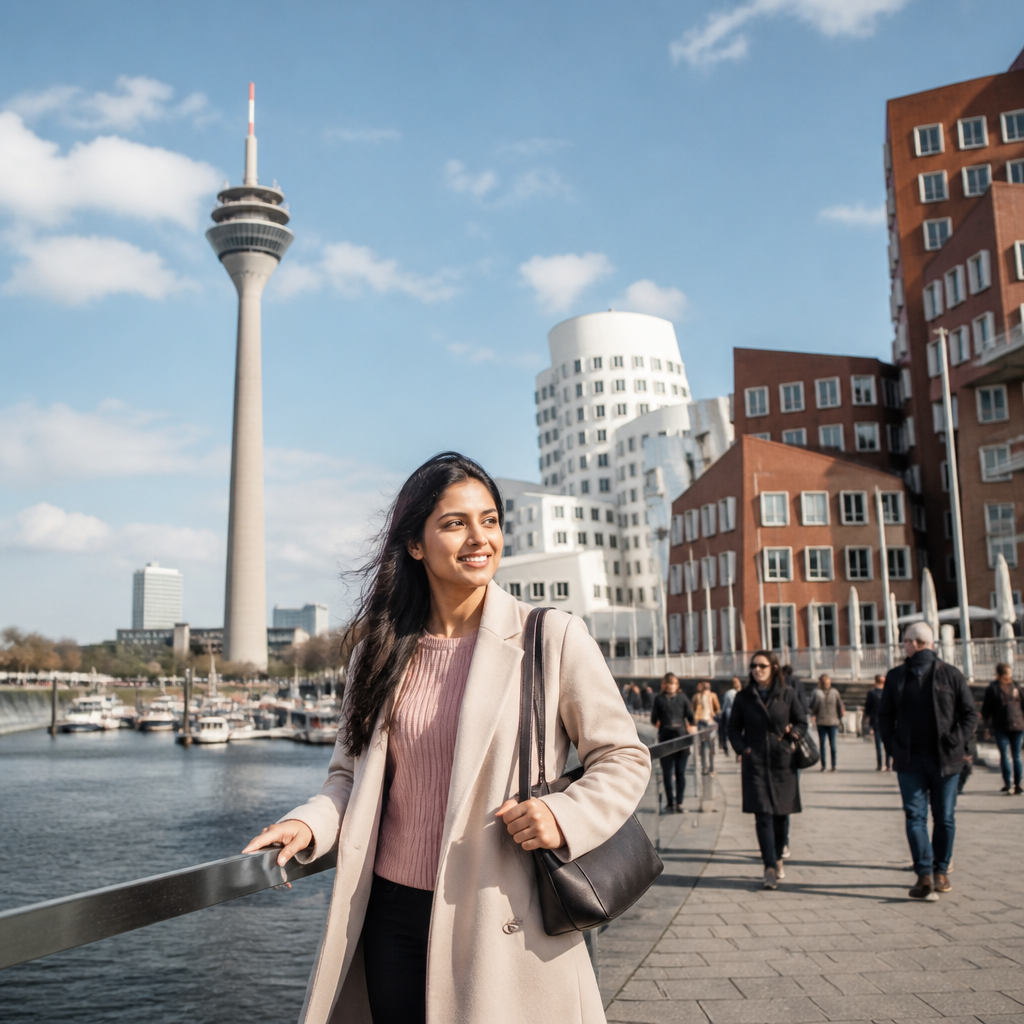
Düsseldorf offers Indian expats something rare among German cities: a cosmopolitan atmosphere where international professionals feel at home from day one, yet everything remains accessible and manageable. As the capital of North Rhine-Westphalia and Germany's seventh-largest city with a 2024 population of 618,685, Düsseldorf punches well above its weight. It's classified as a GaWC Alpha- world city, an international business and financial centre known for its fashion and trade fairs, and headquarters to Fortune Global 500 companies including Uniper and Metro, plus DAX companies like Rheinmetall, Henkel and GEA.
What makes Düsseldorf particularly appealing for Indian families is its blend of economic opportunity and quality of life. Mercer's 2023 Quality of Living survey ranked Düsseldorf the tenth most livable city in the world. The city is culturally diverse, with around 180 nationalities calling it home, creating an environment where you won't feel like an outsider. Düsseldorf Airport is Germany's fourth-busiest, serving as the main international hub for the Ruhr region, making travel back to India and across Europe straightforward.
The city lives up to its "Live Close, Feel Free" slogan. Everything you need—from work to shopping, healthcare to schools—sits within easy reach. The Rhine River creates a natural divide between the historic Altstadt and modern districts like MedienHafen, where cutting-edge architecture by Frank Gehry and Will Alsop stands alongside corporate headquarters. This is a city where medieval squares filled with modern art coexist with technology hubs, where local boutiques share streets with international brands, and where you'll find regional German cuisine alongside authentic multicultural restaurants.
This guide walks you through every essential aspect of establishing your life in Düsseldorf, from your first registration appointment to finding the right neighbourhood for your family, navigating the job market, and understanding daily life in Germany's fashion capital.
Arrival and City Registration: Your First Official Steps
Within your first days in Düsseldorf, you must register your residence (Anmeldung) at the Bürgerbüro. This registration is mandatory for everyone relocating to the city, and you need to complete it soon after moving in—German law requires registration within two weeks of arrival, though specific enforcement timelines should be confirmed with the registration office.
What you'll need for registration:
You must bring several documents to your registration appointment. These include valid identification—a passport or valid passport replacement documentation for foreign citizens—for everyone relocating with you. Non-EU/EEA citizens need their current residence permit or documentation. You'll need to complete the registration form (Anmeldeformular), which is only available in German and must be filled in German. If you don't have a German-speaking friend to help, use a reliable online translator like DeepL.com. Don't forget to sign the completed form.
The most critical document is your move-in confirmation (Wohnungsgeberbestätigung), a written and signed confirmation from your landlord that you've moved into their property. The document lists your basic information, the address, and requires the landlord's signature. You must bring the original. If you're under 18, you'll need written consent and a photocopy of your legal guardian's ID, confirming they consent to you living independently.
Booking your appointment:
You'll need to book an appointment with the Bürgerbüro rather than simply showing up. The city's official portal provides the booking system and current processing information. Processing times and appointment availability are not published in advance, so check the official Düsseldorf city website (duesseldorf.de) for current wait times and book as early as possible after securing your accommodation.
This registration certificate (Meldebescheinigung) becomes essential for nearly everything else you'll do in Germany—opening a bank account, signing up for health insurance, enrolling children in school, and various employment formalities. Keep multiple certified copies; you'll need them repeatedly during your first months.
Visas and Residence Permits: Legal Status for Indian Nationals
Indian nationals require a visa to enter Germany and a residence permit (Aufenthaltstitel) to live and work here. The specifics depend entirely on your purpose: employment, family reunification, study, or business.
Before arrival:
Most Indian expats arrive on a national visa (Type D) obtained from the German Embassy or Consulate in India. This visa allows you to enter Germany and gives you typically 90 days to convert it into a full residence permit. Your employer often guides this process, particularly for skilled workers under the EU Blue Card scheme or standard work permits.
After arrival:
Once in Düsseldorf, you must visit the Ausländerbehörde (Foreigners' Registration Office) to convert your visa into a residence permit. This office handles all residence matters for non-EU citizens. You'll need your passport, visa, registration certificate from the Bürgerbüro, biometric photos, your employment contract or university admission letter, proof of health insurance, and proof of adequate living space.
The official sources for this article do not publish specific processing times or fees for residence permits. These vary based on permit type and individual circumstances. Check the Düsseldorf city website or the North Rhine-Westphalia state portal for current fees and processing information before your appointment. Book your Ausländerbehörde appointment as early as possible—demand is high in all major German cities.
Family members:
Spouses and dependent children can typically join you under family reunification provisions. They'll need their own residence permits, which are usually tied to yours. Spouses generally receive work authorization, allowing them to seek employment in Germany. Children's permits typically allow them to attend school and later pursue vocational training or higher education.
For detailed guidance on specific visa types, work permits, and the latest requirements, consult Expatskey's dedicated visa and immigration articles for Germany, which provide current information on documentation, timelines, and process changes.
Finding Housing in Düsseldorf: Neighborhoods, Costs, and the Rental Reality
The Düsseldorf housing market is competitive but more accessible than Berlin or Munich. Germany has the lowest homeownership rates in the EU, with less than half of inhabitants (49.1%) owning their homes, and renting is the norm, especially for newcomers who want to settle in before considering purchase.
Understanding the rental process:
Once you find a place, you typically pay a deposit of around three months' rent and provide necessary documentation including photo ID and proof of income. This substantial deposit requires planning, particularly when transferring funds from India. Your landlord provides a tenancy agreement (Mietvertrag) detailing both parties' rights and responsibilities.
Homes in Düsseldorf typically consist of a living room (Wohnzimmer), kitchen (Küche), bathroom (Badezimmer), and between one and three bedrooms (Schlafzimmer). Townhouses often have small gardens, while apartments on higher floors may have balconies. Be prepared for "cold rent" (Kaltmiete) versus "warm rent" (Warmmiete)—the former excludes utilities like heating, water, and building maintenance, which are added separately.
Choosing your neighbourhood:
Düsseldorf is divided into 10 districts with various neighbourhoods, each offering distinct character and advantages. The city's relatively small size means everything remains central, without the exhausting rush typical of larger cities.
Oberkassel sits across the Rhine from the city centre, connected by the Rheinkniebrücke bridge. It's an upscale, quiet residential area popular with families and established professionals. Expect higher rents but excellent quality of life, parks, and riverside walks.
Bilk and Unterbilk attract younger professionals and families seeking more affordable options while staying close to the centre. These neighbourhoods offer good transport connections, diverse dining options, and a mix of old and new buildings. If you're working in the MedienHafen area or city centre, these districts keep your commute short.
Düsseltal appeals to families, offering green spaces, good schools, and a more residential feel while remaining well-connected to the centre. Flingern has developed a reputation among younger expats and creatives, with a growing food scene and more affordable rents than central districts.
Hafen and Friedrichstadt keep you closest to the corporate offices in MedienHafen and the city centre, ideal if minimizing commute time is your priority.
Pempelfort and Derendorf offer middle-ground options—more residential than Bilk but more affordable than Oberkassel, with good schools and transport links.
The official sources for this article do not provide specific rental price ranges by neighbourhood. These vary significantly based on property size, condition, exact location, and market conditions. Check current listings on major German property portals like ImmobilienScout24 and Immowelt for up-to-date pricing in your preferred areas.
Practical housing search tips:
Start your search early—ideally before arriving, though viewing in person is usually necessary. Many landlords require a SCHUFA credit report (German credit check), which new arrivals won't have. Some accept alternative documentation like employer references or bank statements showing financial stability. Having your employer vouch for you can help significantly.
Competition for good properties is real. Prepare a complete application package (Bewerbungsmappe) including your ID, proof of income, previous landlord references if available, and a brief cover letter in German introducing yourself. This professionalism helps you stand out.
For comprehensive guidance on the German rental market, tenant rights, and navigating property viewings, refer to Expatskey's detailed housing and accommodation articles.
Employment and Professional Life: Finding Work in Germany's Business Hub
Düsseldorf's economy provides strong opportunities for Indian professionals, particularly in sectors like IT, engineering, finance, consulting, pharmaceuticals, and telecommunications. The city serves as headquarters for major corporations and hosts numerous international firms.
Job market overview:
The official sources for this article do not provide specific employment statistics or sector-specific hiring data for Düsseldorf. For current labour market information, check the Federal Employment Agency (Bundesagentur für Arbeit) website and Düsseldorf's economic development portal.
Many Indian expats arrive with jobs already secured, either through international transfers within their company or direct hiring by German firms. The EU Blue Card scheme facilitates entry for highly qualified non-EU workers, requiring a recognized university degree and a job offer meeting minimum salary thresholds (check current thresholds on the Federal Office for Migration and Refugees website, as these change annually).
Working culture:
German workplace culture values punctuality, direct communication, and clear separation between professional and personal life. Meetings start on time, deadlines are taken seriously, and hierarchies tend to be less pronounced than in Indian corporate environments, with more open discussion expected even with senior management.
Work-life balance is genuinely respected. Most employment contracts specify 40 hours per week, and overtime is tracked carefully. You're entitled to a minimum of 20 vacation days per year (for a five-day work week), though 25-30 days is common. Germans take their vacation time—it's not seen as lack of commitment but as necessary for productivity and wellbeing.
Language in the workplace:
While many international companies operate in English, learning German significantly improves your career prospects and daily life quality. Even in English-speaking workplaces, informal conversations, social events, and some documentation may be in German. Consider enrolling in German courses immediately upon arrival—integration courses (Integrationskurse) are available for newcomers and sometimes subsidized.
Professional networking:
Düsseldorf's international business community offers networking opportunities through chambers of commerce, professional associations, and expat groups. The city's trade fairs (Messe Düsseldorf organizes nearly one-fifth of premier trade shows globally) provide excellent industry networking opportunities.
For detailed information on German employment contracts, workplace rights, and career development strategies, consult Expatskey's dedicated employment and career articles for Germany.
Money, Banking, and Taxation: Managing Your Finances
Setting up your financial infrastructure in Germany requires several steps, and understanding the German banking and tax system helps avoid surprises.
Opening a bank account:
You'll need a German bank account for receiving salary, paying rent, and handling daily transactions. Major banks include Deutsche Bank, Commerzbank, Postbank, and Sparkasse (savings bank). Many expats also use digital banks like N26 or Comdirect for their English-language interfaces and lower fees.
To open an account, you typically need your passport, registration certificate (Meldebescheinigung), and sometimes proof of income or employment contract. Some banks require an in-person appointment; others allow online account opening with video identification.
Understanding German taxation:
Germany operates a progressive income tax system. The official sources for this article do not provide specific tax rates or brackets. These change periodically and depend on your individual circumstances. Check the Federal Ministry of Finance website or consult a tax advisor (Steuerberater) for current rates and your specific situation.
You'll also pay social security contributions, which cover health insurance, pension insurance, unemployment insurance, and long-term care insurance. These are typically split between employer and employee. Your payslip (Lohnabrechnung) shows all deductions clearly.
Germany has a tax treaty with India to prevent double taxation. If you maintain income sources in India, consult a tax advisor familiar with international taxation to ensure compliance in both countries.
Tax identification number:
Shortly after registering your residence, you'll automatically receive a tax identification number (Steueridentifikationsnummer) by mail. This permanent number is essential for employment and tax filing. Keep it safe—you'll need it repeatedly.
Tax filing:
Whether you must file an annual tax return (Steuererklärung) depends on your circumstances. Employees with straightforward situations may not be required to file, as tax is deducted at source. However, filing often results in refunds, especially if you have deductible expenses like work-related costs, commuting expenses, or professional development courses.
Many expats use tax software like WISO Steuer or SteuerGo, or hire a Steuerberater, particularly in their first years when navigating the system feels overwhelming.
For comprehensive guidance on German banking, tax obligations, and financial planning, refer to Expatskey's detailed finance and taxation articles.
Healthcare: Navigating the German Medical System
Germany's healthcare system is excellent but operates differently from India's, and understanding it helps you access care effectively.
Health insurance is mandatory:
Every resident must have health insurance. You'll choose between statutory health insurance (gesetzliche Krankenversicherung, GKV) and private health insurance (private Krankenversicherung, PKV). Most employees earning below a certain threshold (check current limits on the Federal Ministry of Health website) must join statutory insurance. Higher earners and self-employed individuals can choose private insurance.
Statutory insurance covers you and often non-working family members at no additional cost. Major providers include TK (Techniker Krankenkasse), AOK, Barmer, and DAK. Services are comprehensive, covering doctor visits, hospital care, most medications, and preventive care. The official sources for this article do not provide specific premium amounts. These are calculated as a percentage of your gross salary up to a certain ceiling and are split between you and your employer. Check with individual insurance providers for current contribution rates.
Finding doctors:
You'll need to register with a general practitioner (Hausarzt) who becomes your first point of contact for health issues and refers you to specialists when needed. Many doctors in Düsseldorf speak English, particularly in international clinics, but German language skills help, especially when explaining symptoms or understanding treatment options.
Appointments often require booking several weeks in advance for non-urgent matters. For emergencies, visit a hospital emergency department (Notaufnahme) or call 112. For urgent but non-life-threatening issues outside practice hours, contact the on-call doctor service at 116 117.
Prescriptions and pharmacies:
Doctors issue prescriptions (Rezept) for medications, which you fill at a pharmacy (Apotheke). Pharmacies are everywhere in Düsseldorf, and pharmacists provide knowledgeable advice on over-the-counter medications. A rotating schedule ensures some pharmacies remain open nights and weekends (Notdienst-Apotheke).
Cultural differences:
German doctors tend toward conservative treatment, prescribing fewer medications than you might expect. Antibiotics, for instance, are prescribed more sparingly than in India. Rest, natural remedies, and time for the body to heal are often recommended first.
For detailed information on choosing health insurance, accessing specialized care, and understanding your rights as a patient, consult Expatskey's healthcare articles for Germany.
Education and Childcare: Schools and Early Years for Your Children
Düsseldorf offers diverse educational options for Indian expat families, from German public schools to international schools teaching in English.
Childcare (Kita):
For children under school age, Kindergarten or Kindertagesstätte (Kita) provides childcare and early education. Spaces are in high demand, and you should register your child as early as possible—ideally during pregnancy or immediately upon learning you're moving to Düsseldorf. The official sources for this article do not provide specific wait times or costs for Kita places. These vary by provider (municipal, church-run, or private) and your income. Contact Düsseldorf's Jugendamt (Youth Welfare Office) for current information on availability and application procedures.
German public schools:
The German school system is free and high-quality but operates differently from India's. Children typically start primary school (Grundschule) at age six, attending for four years. After Grundschule, the system divides into different school types—Gymnasium (academic track leading to university), Realschule (intermediate track), and Hauptschule (vocational track)—though comprehensive schools (Gesamtschule) are increasingly common.
Public schools teach in German. Children joining the system without German language skills may receive additional language support, but the transition can be challenging. Consider this carefully based on your child's age and how long you plan to stay in Germany.
International schools:
Düsseldorf hosts several international schools offering English-language education with international curricula (IB, British, or American systems). These ease the transition for children and provide continuity if you relocate again. However, they charge substantial tuition fees. The official sources for this article do not provide specific fee amounts for international schools in Düsseldorf. Contact schools directly for current tuition, admission requirements, and availability.
International schools often have waiting lists, so apply as early as possible—ideally before relocating. Some employers offer education allowances covering partial or full tuition as part of expat packages.
Curriculum and school life:
German schools emphasize independent learning, critical thinking, and project work rather than rote memorization. Homework loads are generally lighter than in Indian schools, particularly in primary years. The school day often ends early (sometimes by 1 PM), though full-day schools (Ganztagsschule) are becoming more common.
School holidays are generous—approximately 12 weeks per year across various breaks. Plan childcare for these periods, as working parents need solutions.
For comprehensive guidance on choosing schools, navigating admissions, and supporting your child's education in Germany, refer to Expatskey's detailed education articles.
Transportation: Getting Around Düsseldorf and Beyond
Düsseldorf's compact size and excellent public transport make getting around straightforward, whether you rely on public transit, cycling, or driving.
Public transportation:
The Rheinbahn operates Düsseldorf's public transport network, including trams (Straßenbahn), light rail (U-Bahn), and buses. The system is efficient, punctual, and covers the entire city and surrounding region. Services integrate with the larger VRR (Verkehrsverbund Rhein-Ruhr) network, allowing seamless travel throughout the Rhine-Ruhr metropolitan area, including to Cologne, Essen, and other nearby cities.
Tickets and fares:
The official sources for this article do not provide specific ticket prices for Düsseldorf's public transport. These vary by zone and ticket type (single journey, day pass, monthly subscription). Check the Rheinbahn website for current fares and ticket options.
You can buy tickets from machines at stations, through the Rheinbahn app, or at service centres. Monthly subscription tickets (Monatsticket or Abo) offer the best value for regular commuters. Some employers offer job tickets (Jobticket) at discounted rates.
Validate your ticket: Always validate time-stamped tickets before boarding by inserting them into the yellow validation machines at platforms. Inspectors conduct regular checks, and riding without a valid ticket incurs substantial fines.
Cycling:
Düsseldorf is relatively bike-friendly, with dedicated cycle paths and flat terrain. Many residents cycle year-round. You can buy a bike from local shops or second-hand through platforms like eBay Kleinanzeigen. Bike theft exists, so invest in a quality lock and register your bike with the police.
Bike rental schemes operate in the city, though regulations exist about where rental bikes can be parked in public spaces.
Driving:
If you drive, you can use your Indian driving license temporarily (usually up to six months), but you'll eventually need to convert it to a German license. The process varies based on bilateral agreements and may require theory and practical tests. Check with your local Führerscheinstelle (driver's license office) for current requirements.
Parking in central Düsseldorf can be challenging and expensive. Many residents rely on public transport for daily commuting and use cars primarily for weekend trips or shopping.
Regional and international travel:
Düsseldorf Airport connects you to destinations worldwide, with direct flights to India available. The airport sits about 10 kilometres from the city centre, easily reached by S-Bahn, bus, or taxi.
The central train station (Düsseldorf Hauptbahnhof) offers excellent rail connections throughout Germany and Europe. High-speed ICE trains reach Cologne in under 30 minutes, Frankfurt in about 90 minutes, and Berlin in approximately four hours.
For detailed guidance on transportation options, getting a German driver's license, and navigating regional travel, consult Expatskey's transport and mobility articles.
Culture and Daily Life: Settling into the Düsseldorf Rhythm
Understanding daily life rhythms and cultural norms helps you settle more comfortably into Düsseldorf society.
The Sunday shutdown:
Everything closes on Sundays in Germany—supermarkets, most shops, and many services. This takes adjustment, but you'll soon learn to plan your shopping for Saturday or weekday evenings. Restaurants, cafes, and cultural venues remain open, making Sundays ideal for leisure activities, riverside walks, or exploring the city's parks and museums.
Rules and punctuality:
Germans value rules and order. You'll notice this everywhere—from pedestrians waiting for the green light even when no cars approach, to strict adherence to quiet hours (Ruhezeiten), typically 22:00-07:00 on weekdays and all day Sunday. Loud activities like drilling, lawn mowing, or playing loud music during these times will prompt complaints from neighbors.
Punctuality is taken seriously. Arriving late to appointments, meetings, or social gatherings is considered disrespectful. If you're running late, call ahead to inform the other party.
Recycling and waste separation:
Germany takes waste separation seriously. You'll have separate bins for paper (Papier), packaging (Gelber Sack or Gelbe Tonne), bio-waste (Biotonne), and general waste (Restmüll). Glass goes to public collection points, sorted by color. Learning this system is essential—improper disposal can result in fines and neighbor complaints.
Social life and community:
Germans often maintain clear boundaries between professional and personal life. Workplace colleagues may not become close friends, and social circles often form through hobbies, sports clubs (Vereine), or children's activities rather than work.
Düsseldorf's international community offers numerous expat groups, cultural associations, and networking events. The city's diversity means you'll find other Indian families and professionals, making the transition easier. Local Indian cultural associations organize events around major festivals like Diwali, Holi, and Indian Independence Day.
Exploring Düsseldorf's cultural offerings:
Düsseldorf has a strong cultural scene. The Altstadt (old town) is the historic heart, lively especially on weekends, known for its bars and restaurants serving local specialties. The Rhine promenade (Rheinuferpromenade) offers beautiful riverside walks, particularly popular in summer.
Königsallee (locally known as the "Kö") is Düsseldorf's premier shopping boulevard, featuring elegant boutiques, designer shops, and a picturesque canal running through its heart. For more eclectic shopping and street art, explore Kiefernstraße in Flingern.
The city's art scene is impressive. Joseph Beuys, the influential postwar artist, was a professor at the Kunstakademie, and Düsseldorf nurtured the influential Düsseldorf school of photography, including Andreas Gursky. The Kunstsammlung Nordrhein-Westfalen, K20, and other galleries showcase modern and contemporary art.
MedienHafen, the transformed harbor district, features striking contemporary architecture alongside restaurants and offices. The Rheinturm (Rhine Tower) offers panoramic city views. Schloss Benrath, a baroque palace with beautiful gardens, sits in the southern part of the city.
The city hosts numerous festivals and events throughout the year, from Christmas markets in winter to summer festivals along the Rhine. The Düsseldorf Card offers discounted or free entry to museums and attractions plus public transport access.
Finding Indian groceries and restaurants:
Düsseldorf's multicultural character means you'll find Indian groceries and restaurants, easing the transition from home. Several stores stock Indian spices, lentils, rice varieties, frozen items, and fresh vegetables essential for Indian cooking.
For dining out, Düsseldorf offers several authentic Indian restaurants serving both North and South Indian cuisine.
Weather and seasons:
Düsseldorf experiences four distinct seasons. Summers (June-August) are generally pleasant, with temperatures ranging from mild to warm—ideal for outdoor activities and exploring the city. Winters (December-February) can be cold and grey, with occasional snow. Rain is possible year-round, so keep an umbrella handy.
The official sources for this article do not provide specific temperature ranges or rainfall statistics for Düsseldorf. For current weather information and seasonal planning, check reliable weather services.
Making Düsseldorf Your Home
Düsseldorf offers Indian expats a unique combination: a thriving international business environment, genuine quality of life, manageable city size, and strong infrastructure for families. The initial administrative hurdles—registration, residence permits, finding housing—require patience and thorough documentation, but once established, daily life flows smoothly.
The city's international character means you won't feel isolated, yet it's German enough that you'll experience authentic German culture and have genuine opportunities to integrate. Your children can access excellent education, you'll find professional opportunities in a strong economy, and the healthcare system provides security and quality care.
Learning German accelerates your integration and opens doors professionally and socially. Even basic German helps with daily tasks, from grocery shopping to chatting with neighbors. Many cities offer integration courses combining language instruction with cultural orientation—take advantage of these.
Connect with Düsseldorf's Indian community through cultural associations, temples, and social media groups. These connections provide practical advice, cultural familiarity, and friendship networks that make the transition smoother.
Düsseldorf may not have Berlin's buzz or Munich's alpine backdrop, but it offers something equally valuable: a balanced, prosperous, and genuinely livable city where you can build a stable, comfortable life while pursuing career growth and providing excellent opportunities for your family. The Rhine flows through the city center, the Altstadt buzzes with energy, and the MedienHafen showcases Germany's modern face—all within easy reach of your home.
Welcome to Düsseldorf. With preparation, patience, and openness to your new environment, you'll find this fashion capital becomes not just your residence, but genuinely your home.