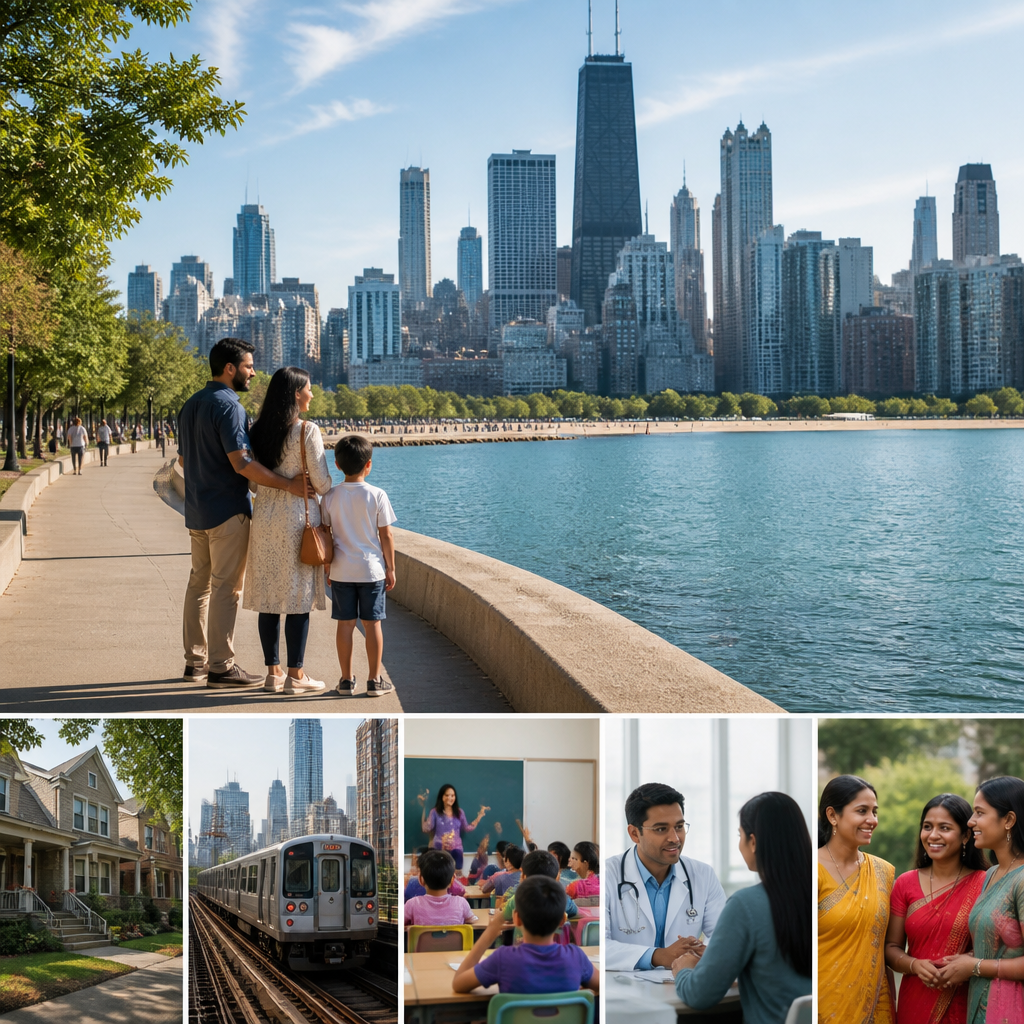
Chicago, the third-largest city in the United States, has quietly become one of the most welcoming destinations for Indian professionals and families seeking opportunity without the eye-watering costs of coastal hubs. With a thriving tech sector, world-class universities, a deeply rooted Indian community centred around Devon Avenue, and a cost of living that sits comfortably below New York or San Francisco, Chicago offers Indian expats a compelling blend of career prospects, cultural familiarity, and Midwestern livability.
This guide is your orientation to expat life in Chicago. It walks you through the essential domains—arrival and registration, housing, transport, healthcare, schools, banking, and community—providing context and direction for each, with links to deeper topic articles where you'll find the procedural detail. Think of this as your city map: it won't tell you every turn, but it will show you which neighbourhoods matter, which systems you'll navigate first, and where to find the Indian groceries, temples, and networks that make a foreign city feel like home.
Arrival and City Registration
Unlike many European cities, the United States does not operate a municipal registration system. When you arrive in Chicago, there is no Anmeldung, no city hall appointment to declare your address, and no local residency certificate to collect. Your legal status is governed entirely by your federal visa and, if applicable, your state driver's licence or ID card.
What You Must Do Upon Arrival
Secure your Social Security Number (SSN): If you are on a work visa (H-1B, L-1, E-2, O-1), you are eligible to apply for an SSN shortly after arrival. You will need this number to open bank accounts, sign lease agreements, establish credit, and file taxes. Visit your nearest Social Security Administration office with your passport, visa, I-94 arrival record, and employment authorisation documents.
Activate your visa status: Ensure your employer files any required notifications with USCIS and that your I-94 record reflects your lawful entry. This is your proof of legal status in the United States.
Register with the Consulate General of India in Chicago: The Consulate General of India in Chicago requests that all Indian citizens residing in the Chicago consular jurisdiction—whether for work, study, or short-term visits—register themselves with the mission. Registration is voluntary but strongly recommended: it ensures the consulate can reach you in emergencies, facilitates passport and visa services, and connects you to community alerts. You can complete this registration online through the consulate's portal.
Visas and Work Permits
Your ability to work in the United States depends entirely on your visa category. H-1B visa holders and their H-4 dependents (who have received Employment Authorization Documents), L-1 intracompany transferees, and O-1 visa holders are authorized to work. Many other dependent visa categories, including some spousal visas, do not automatically grant work permission. One expat interviewed noted the importance of understanding this upfront: "Prospective expats and their spouses must be aware of a very important point: being allowed to work in the US depends on their visa. According to visas, dependents of expats are not always allowed to work."
Expatskey's dedicated visa and work permit articles provide the procedural depth and latest policy updates; consult those before making employment or relocation decisions.
Finding Housing in Chicago: Neighbourhoods and Costs
Housing will be your largest monthly expense in Chicago, and choosing the right neighbourhood shapes everything from your commute to your children's schools to your access to Indian groceries and community.
Recommended Neighbourhoods for Indian Expats
Lincoln Park, Lakeview, and Bucktown are consistently recommended for expat families. These North Side neighbourhoods offer tree-lined streets, proximity to excellent public and private schools, parks, and a family-friendly atmosphere. One French expat living in Chicago since 2008 specifically highlighted these areas: "For expat families, I recommend living in neighbourhoods such as Lincoln Park, Lakeview, and Bucktown."
West Rogers Park and Devon Avenue: This area, centred on Devon Avenue between Western and Kedzie Avenues, is the heart of Chicago's Indian community. Here you'll find Indian grocery stores, restaurants, sari shops, jewellers, and temples. It is less expensive than Lincoln Park and offers immediate cultural familiarity, though commutes to downtown can be longer.
Naperville and Evanston (suburbs): If you prefer suburban life, both Naperville and Evanston rank among the best places to live in the United States for 2026, according to a recent national assessment. Naperville, located west of the city, ranked No. 4 nationally for its strong public services, well-developed infrastructure, and manageable commute times. Evanston, immediately north of Chicago along Lake Michigan, ranked No. 13 and offers proximity to Northwestern University, excellent schools, and convenient access to downtown Chicago. The analysis noted that the cost of living in Chicago suburbs such as Oak Park and Naperville is 20–30% lower than downtown, making them attractive for families.
Housing Costs
According to available data, one-bedroom apartments in the city centre cost $2,300–$2,600 (₹1.90–₹2.15 lakh) per month, while those outside the city centre range from $1,600 to $1,900 (₹1.4–₹1.52 lakh). Three-bedroom apartments in the city centre cost approximately $4,700 per month, while those outside the centre average $2,800 per month. For families, housing is often the single largest budget item, with total monthly expenses for a family of four averaging $4,600–$4,900 (₹3.64–₹3.88 lakh).
Lease agreements in Chicago typically require first month's rent, a security deposit (often one month's rent), and proof of income (usually 2.5 to 3 times the monthly rent). Landlords will check your credit history; as a new arrival, you may need to provide additional documentation such as bank statements, employment letters, or even offer several months' rent upfront.
Where to Search
Popular rental platforms include Zillow, Apartments.com, Domu (Chicago-specific), and Craigslist. Many expats also work with real estate agents who specialize in rentals; agent fees are less common in Chicago than in cities like New York, but clarify this upfront.
Expatskey's dedicated housing article provides a step-by-step guide to lease terms, tenant rights, utilities setup, and neighbourhood comparisons.
Public Transport and Getting Around Chicago
Chicago's public transportation system, operated by the Chicago Transit Authority (CTA), is one of the most extensive in the United States. It consists of an elevated and subway rail network (the 'L') and an extensive bus system covering the city and many near suburbs.
CTA Fares and Passes
A single-ride fare on CTA buses and trains costs $2.50. A monthly unlimited pass costs $75–$120 (₹5,900–₹9,500), making it the most affordable commuting option for daily users. You can purchase and load passes onto a reusable Ventra card, available at CTA stations, Walgreens, and CVS stores, or use the Ventra mobile app.
Metra and Pace
For suburban commuters, Metra operates commuter rail lines radiating from downtown Chicago to suburbs including Naperville, Evanston, and beyond. Fares are zone-based; a monthly pass from Naperville to downtown, for example, will cost more than a CTA pass, but the official sources for this article do not publish specific Metra monthly pass prices. Check the Metra website for current fare calculators and pass options.
Pace operates suburban bus routes connecting areas not served by CTA or Metra.
Driving and Car Ownership
Many expats, especially those living in the suburbs, find owning a car necessary. Costs include the vehicle purchase or lease, fuel, insurance (which can be high for new drivers without a U.S. driving history), parking (which in downtown areas can be expensive), and maintenance. The sources for this article do not provide specific figures for car ownership costs in Chicago; budget carefully and research insurance quotes before committing.
You can drive on an Indian driver's licence for a limited period (typically 90 days, though this varies by state), after which you must obtain an Illinois driver's licence. This requires passing a written test, a vision test, and a driving test. Bring your passport, visa documents, proof of residency (lease agreement or utility bill), and Social Security Number.
Ride-Sharing
Uber and Lyft operate extensively throughout Chicago and are convenient for occasional trips, though costs add up quickly for daily commuting.
Expatskey's transport guide provides detailed instructions on obtaining an Illinois driver's licence, registering a vehicle, and navigating winter driving conditions.
Healthcare and Health Insurance
The United States does not have a universal public healthcare system. Healthcare is predominantly private, and costs are high. Securing comprehensive health insurance before you arrive is not optional—it is essential.
Health Insurance
Most expats obtain health insurance through their employer, which typically covers a significant portion of premiums. Employer-sponsored plans vary widely in coverage, deductibles, co-pays, and networks. Health insurance premiums average $250–$400 (₹19,800–₹31,600) per month depending on coverage, though employer contributions often reduce the employee's share substantially.
If you are self-employed, a student, or a dependent without employer coverage, you will need to purchase insurance privately through the Health Insurance Marketplace (healthcare.gov) or directly from insurers. Be prepared for higher premiums and carefully compare plans' deductibles, out-of-pocket maximums, and provider networks.
Finding Doctors and Hospitals
Chicago is home to world-class hospitals and medical centres, including Northwestern Memorial Hospital, Rush University Medical Center, and the University of Chicago Medical Center. Many doctors and specialists are internationally trained, and English is the standard language of care.
When choosing a doctor, ensure they are "in-network" for your insurance plan to avoid significantly higher costs. Most insurance companies provide online directories of in-network providers.
Prescriptions and Pharmacies
Prescription medications are filled at pharmacies such as Walgreens, CVS, and Osco, which are ubiquitous throughout Chicago. Bring your insurance card; co-pays for prescriptions vary depending on your plan and the medication.
Costs
Even with insurance, you will typically pay co-pays for doctor visits, prescriptions, and specialist appointments. Emergency room visits and hospital stays can result in substantial bills even after insurance coverage. Review your plan's summary of benefits carefully and keep an emergency fund for unexpected medical expenses.
Expatskey's healthcare guide explains U.S. health insurance terminology (deductibles, co-pays, co-insurance, out-of-pocket maximums), how to choose a plan, and how to navigate billing and claims.
Education and Childcare: Schools and Daycares
Chicago offers a wide range of educational options for expat children, from excellent public schools to private, international, and specialized institutions.
Public Schools
Public schools in Chicago are free to attend for residents and are administered by Chicago Public Schools (CPS). Quality varies significantly by neighbourhood; schools in areas like Lincoln Park, Lakeview, and the North Side generally have strong reputations, while schools in other areas face greater challenges. Research individual schools using the CPS website and GreatSchools.org ratings before choosing where to live.
Enrollment requires proof of residency (lease agreement or utility bill), your child's birth certificate, immunization records, and, if applicable, previous school records.
Private and International Schools
Many expat families choose private or international schools for curriculum continuity, smaller class sizes, and globally recognized qualifications. Schools that expat children commonly attend include the Lycée Français of Chicago, the British School of Chicago, the Latin School, the University of Chicago Laboratory Schools, and Francis W. Parker School.
The official sources for this article do not publish current tuition fees for these institutions. Tuition at private and international schools in major U.S. cities typically ranges into the tens of thousands of dollars per year; contact schools directly for current fee schedules, admission requirements, and availability.
Childcare and Preschools
Childcare for infants and toddlers, and preschool programs for children aged 3-5, are widely available but costly. The sources for this article do not provide specific childcare costs in Chicago. Expect to research and budget carefully; many working parents find childcare to be their second-largest expense after housing. Waiting lists for highly regarded centres can be long, so begin your search early.
Expatskey's education guide provides a detailed comparison of public, private, and international school systems, the U.S. school calendar, extracurricular expectations, and how to evaluate schools for your child's needs.
Banking, Money, and Finances
Opening a U.S. bank account early is essential for receiving salary payments, paying rent, and building a credit history.
Opening a Bank Account
Major banks operating in Chicago include Chase, Bank of America, Citibank, and U.S. Bank. To open an account, you will need your passport, visa documents, Social Security Number (or a letter from the SSA stating you have applied), proof of address (lease agreement or utility bill), and an initial deposit.
Many banks offer checking accounts (for daily transactions) and savings accounts (for interest-bearing deposits). Ask about monthly fees, minimum balance requirements, ATM access, and online banking features.
Building Credit
The United States operates on a credit score system that influences your ability to rent apartments, obtain car loans, and secure favorable interest rates. As a new arrival, you will have no U.S. credit history. Strategies to build credit include:
- Applying for a secured credit card (which requires a cash deposit as collateral)
- Becoming an authorized user on someone else's credit card
- Using a credit-builder loan
- Paying all bills on time
Building credit takes time—typically six months to a year before you have a score—but it is critical for long-term financial health in the U.S.
Taxes
The U.S. tax system is complex. You will file federal income taxes with the IRS and state income taxes with Illinois. Your employer will withhold taxes from your paycheck, but you are responsible for filing annual returns (typically due April 15). Many expats work with accountants or tax preparers, especially in the first few years, to navigate deductions, treaty benefits (if applicable under the U.S.-India tax treaty), and reporting requirements for foreign assets.
Expatskey's banking and tax articles provide step-by-step guidance on account setup, understanding pay stubs, filing taxes, and managing cross-border finances.
Indian Community, Groceries, and Cultural Life
Chicago's Indian community is large, vibrant, and deeply embedded in the city's cultural fabric. You will find it easy to access Indian groceries, celebrate festivals, and connect with fellow expats.
Devon Avenue: The Heart of Indian Chicago
Devon Avenue, particularly the stretch between Western and Kedzie Avenues in the West Rogers Park neighbourhood, is Chicago's Little India. Here you will find dozens of Indian grocery stores, restaurants, sweet shops, sari boutiques, jewellers, and service providers. It is the go-to destination for everything from fresh produce and spices to Bollywood DVDs and festival supplies.
Indian Restaurants
Chicago's Indian dining scene is diverse and excellent, spanning regional cuisines from North to South India.
Temples and Religious Institutions
Several Hindu temples serve the Chicago area, including the Hindu Temple of Greater Chicago in Lemont (one of the oldest and largest in the Midwest), the Bochasanwasi Akshar Purushottam Swaminarayan Sanstha (BAPS) Shri Swaminarayan Mandir in Bartlett, and the Arya Samaj Greater Chicago in Palatine. Sikh gurdwaras, Jain centres, and Islamic mosques are also present throughout the metropolitan area.
Community Organizations
The Federation of Indian Associations (FIA) Chicago is one of the most influential umbrella organizations representing the Indian diaspora in the Chicagoland area, uniting community groups and organizing cultural events, networking opportunities, and advocacy efforts.
Festivals and Events
Chicago's Indian community celebrates all major festivals—Diwali, Holi, Navratri, Eid, Vaisakhi—with public events, cultural programs, and gatherings. The annual India Independence Day parade and festival, held in August, is one of the largest in the United States.
Making Friends and Building Networks
One expat noted the ease of building social connections in Chicago: "I know more people here in Chicago after one and a half years than after spending three years in Nantes, France!" Professional networking groups, alumni associations (many Indian universities have active Chicago chapters), parent groups at schools, and neighbourhood associations all provide avenues to meet people.
Cost of Living: Budgeting for Chicago
While Chicago is more affordable than New York or San Francisco, it is by no means a cheap city. On average, the cost of living in Chicago per month for a single person is $1,200–$1,350 (₹99,600–₹1,12,050) excluding rent. For families of four, monthly expenses average $4,600–$4,900 (₹3.64–₹3.88 lakh).
Breakdown of Monthly Costs
Groceries: For a single person, groceries typically cost $200–$400 (₹16,600–₹33,200) per month depending on lifestyle and where you shop. Cooking at home is significantly cheaper than dining out.
Dining Out: A meal at a campus cafeteria or casual restaurant may cost around $7–$10 per person, while dining at mid-range restaurants averages $20–$30 per meal. Chicago's food scene is known for value, offering world-class dining at lower prices than equivalent venues in other major cities.
Utilities: The sources for this article do not provide specific utility costs for Chicago. Budget for electricity, gas (especially important for winter heating), water, internet, and mobile phone service. Tracking these expenses helps keep monthly costs manageable.
Entertainment: Entertainment and leisure in Chicago are generally more affordable than in many other U.S. cities. There are many free or low-cost activities: public parks, lakefront trails, free museum days, and numerous music and arts festivals throughout the year.
Comparing Chicago to Other U.S. Cities
Chicago sits in the middle of the U.S. cost-of-living spectrum. It is significantly cheaper than Boston (where families often spend $6,000+ monthly) and more expensive than Atlanta (where families average $3,500–$4,200 monthly).
Expatskey's cost-of-living guide provides detailed budget templates, neighbourhood cost comparisons, and strategies for managing expenses as a new arrival.
Culture, Daily Life, and Practical Tips
Safety
Chicago has a mixed reputation for safety. While certain neighbourhoods experience higher crime rates, the areas where most expats live and work—downtown, the North Side, and many suburbs—are generally safe. One expat noted: "Otherwise, Chicago is rather safe for a US city." Use common sense, stay aware of your surroundings, and research specific neighbourhoods before choosing where to live.
Weather
Chicago experiences four distinct seasons. Winters are cold, snowy, and windy (hence the nickname "Windy City"), with temperatures often below freezing from December through February. Summers are warm and humid. Spring and autumn are mild and pleasant. Invest in a good winter coat, boots, and layers if you are arriving from a warmer climate.
What Locals Are Like
Chicagoans are generally friendly, straightforward, and proud of their city. Midwestern hospitality is real; people are more likely to strike up conversations and offer help than in some coastal cities. The city has a strong neighbourhood identity, and locals are passionate about their sports teams (Cubs, White Sox, Bears, Bulls, Blackhawks).
Free and Low-Cost Activities
Chicago offers an abundance of free or inexpensive activities: Millennium Park, Navy Pier, the lakefront trail (18 miles of scenic paths along Lake Michigan), free days at major museums (Art Institute of Chicago, Field Museum, Museum of Science and Industry), outdoor concerts, neighbourhood festivals, and public beaches in summer.
Final Thoughts: Making Chicago Home
Chicago is a city that rewards those who engage with it. It is not as instantly glamorous as New York or as perpetually sunny as Los Angeles, but it offers something increasingly rare in American cities: a genuine quality of life at a manageable cost, a welcoming community, and the infrastructure to support families, careers, and long-term roots.
For Indian expats, Chicago provides the dual advantage of professional opportunity and cultural familiarity. You will find your favourite foods, your festivals, your temples, and your community here. You will also find excellent schools, world-class healthcare, reliable public transport, and neighbourhoods where children can grow up safely.
The bureaucracy is lighter than in many countries—no municipal registration, no local permits—but the systems you do navigate (visas, health insurance, credit scores) require attention and planning. Use this guide as your starting point, consult Expatskey's deeper topic articles for procedural detail, and connect with the community early. Chicago, with its blend of Midwestern warmth and global ambition, is ready to welcome you home.